---
title: "Ingest UCSD SIO Mesopelagic Fish"
calcofi:
target_name: ingest_sio_mesopelagic_fish
workflow_type: ingest
dependency:
- ingest_swfsc_ichthyo
output: data/parquet/sio_mesopelagic-fish/manifest.json
provider: sio
dataset: mesopelagic-fish
workflow_url: https://calcofi.io/workflows/ingest_sio_mesopelagic-fish.html
questions_file: metadata/sio/mesopelagic-fish/questions.csv
dataset_meta:
dataset_name: UCSD SIO Mesopelagic Fish
# display trio, read by the release `dataset` table and the
# consumer apps (calcofi4db >= 3.15.0) — see NEWS for why these
# left the apps' own hardcoded maps
dataset_name_short: Mesopelagic Fish
category: Mesopelagic Fish
color: "#a809d1"
# publishes the consolidated core: the source shape is wrangled in the notebook
# and projected into the shared core tables.
tables_owned:
- {table: sample, shared: true, note: "core event dimension (tow grain)"}
- {table: obs, shared: true, note: "core occurrence headline (bio, per-tow tally)"}
- {table: taxon, shared: true, note: "shared taxa reference"}
- {table: dataset_taxon, shared: true, note: "scientific name -> taxon_key crosswalk"}
- {table: measurement_type, shared: true}
erd:
color: "#bbe0f0"
editor_options:
chunk_output_type: console
---
## Overview
**Source**: `bb9217084g_1_1.xlsx`, sheet `Sheet1` ("Final Data"), UC San
Diego Library Digital Collections. 102 tows, 7 cruises, 2010-01 to 2012-02.
Provider `sio` (SIO curates the dataset; CalCOFI is the sampling
program, not the curating org).
## Setup
```{r}
#| label: setup
#| message: false
devtools::load_all(here::here("../calcofi4db"))
devtools::load_all(here::here("../calcofi4r"))
librarian::shelf(
  CalCOFI/calcofi4db, CalCOFI/calcofi4r,
  DBI, dplyr, DT, fs, glue, here, janitor, jsonlite, knitr, lubridate, purrr,
  readr, readxl, sf, stringr, tibble, tidyr, units, quiet = T)
options(readr.show_col_types = F)
options(DT.options = list(scrollX = TRUE))

source(here("libs/ingest.R"))

cc           <- read_calcofi_meta(here("ingest_sio_mesopelagic-fish.qmd"))
provider     <- cc$provider
dataset      <- cc$dataset
tables_owned <- cc$tables_owned
dir_label    <- glue("{provider}_{dataset}")
dir_parquet  <- here(glue("data/parquet/{dir_label}"))
dir_stage  <- cc_stage_path("parquet", dir_label, create = TRUE)
db_path      <- here(glue("data/wrangling/{dir_label}.duckdb"))

if (overwrite) {
  if (file_exists(db_path))                 file_delete(db_path)
  if (file_exists(paste0(db_path, ".wal"))) file_delete(paste0(db_path, ".wal"))
  if (dir_exists(paste0(db_path, ".tmp")))  dir_delete(paste0(db_path, ".tmp"))
}
dir_create(dirname(db_path))
con <- get_duckdb_con(db_path)
load_duckdb_extension(con, "spatial")

meas_type_csv <- here("metadata/measurement_type.csv")
d_meas_type   <- read_measurement_type(meas_type_csv)
```
## Read Source
Fetched reproducibly by `libs/download_mesopelagic_fish.R` from the UCSD Library
Digital Collections object (`bb9217084g`), whose download URL is derived from
the object id — no landing-page scraping.
```{r}
#| label: read-source
source(here("libs/download_mesopelagic_fish.R"))
fish_xlsx <- download_mesopelagic_fish(
  path_expand(glue("{dir_data}/{provider}/{dataset}")),
  overwrite = overwrite_all)
stopifnot("mesopelagic fish xlsx not found" = file_exists(fish_xlsx))

sync_to_gcs(
  local_dir  = path_dir(fish_xlsx),
  gcs_prefix = glue("archive/{provider}/{dataset}"),
  bucket     = "calcofi-files-public",
  exclude    = c(".DS_Store"))
d_raw <- read_excel(fish_xlsx, sheet = "Sheet1")
species_cols <- setdiff(names(d_raw), c(
  "CruiseID", "Tow", "Station", "LatFinal", "LongFinal",
  "Month", "Year", "Time", "CalDepth", "VolFilt", "DensityTotal", "Abundance"))
cat(glue("Read {nrow(d_raw)} tows, {length(species_cols)} species columns"), "\n")
# Q03 (RESOLVED): the same workbook has a hidden 'Original' sheet (raw
# field log, not the curated 'Final Data') with a real per-tow Date of Tow
# plus separate Start hour/Start Minute integer fields AND an explicit
# Time Zone column (PST/PDT, i.e. genuinely DST-aware, not a fixed
# assumption). Joinable to Sheet1 by CruiseID + Tow. See datetime
# derivation below for cross-validation against Sheet1's own Time field.
d_orig <- read_excel(fish_xlsx, sheet = "Original") |>
  select(CruiseID = `Cruise ID`, Tow, date_of_tow = `Date of Tow`,
         orig_hour = `Start hour`, orig_minute = `Start Minute`,
         time_zone = `Time Zone`) |>
  filter(!is.na(date_of_tow), !is.na(CruiseID), !is.na(Tow)) |>
  mutate(CruiseID = as.integer(CruiseID), Tow = as.integer(Tow))
cat(glue("Read {nrow(d_orig)} dated tow records from 'Original' sheet"), "\n")
# FYI, not an action item: 'Original' also contains a full 8th cruise,
# 1210 (Oct 2012, 16 tows), with its own Date of Tow/hour/minute/TZ --
# but 1210 has zero rows in Sheet1 (the curated "Final Data" this ingest
# is built from), so it never enters d_tow/d_meas -- the left_join below
# keeps Sheet1 as the row set and only attaches matching Original columns.
```
## Build Tow + Measurement Tables
All 7 cruises ran on RV New Horizon (NODC `32NM`) -- established during
drafting by a one-time manual cross-check against `calcofi_bottle` casts
(cruise ID + station + lat/lon overlap); hardcoded here as a constant, not
a live join at ingest time (no ship column in the source, and this ingest
no longer depends on `calcofi_bottle` at runtime -- see Add Spatial).
`Time` (Sheet1) is `HH.MM` per the source's own `Header Definitions` sheet
(e.g. `23.57` = 23:57), confirmed directly against that sheet -- but see
below, a second sheet in the same workbook supersedes it for full
datetime derivation. Species columns are raw individual counts
("numbers in the sample" per Header Definitions), pivoted to
`measurement_type = 'abundance'` — the shared registry's per-net
specimen-count type, also used by `swfsc_ichthyo`.
```{r}
#| label: build
d <- d_raw |>
  mutate(tow_id = row_number(), .before = 1) |>
  left_join(d_orig, by = c("CruiseID", "Tow")) |>
  mutate(
    cruise_key = glue("20{substr(CruiseID,1,2)}-{substr(CruiseID,3,4)}-32NM") |> as.character(),
    latitude   = as.numeric(LatFinal),
    longitude  = -1 * as.numeric(LongFinal),  # source stores unsigned degrees-west
    sheet1_hour   = as.integer(floor(Time)),
    sheet1_minute = as.integer(round((Time - floor(Time)) * 100)))

# Q03 (RESOLVED): cross-validated sheet1_hour/sheet1_minute (Sheet1's
# packed HH.MM Time) against orig_hour/orig_minute (Original's separate
# integer fields) for all 102 tows. Two distinct discrepancy patterns
# found, handled differently:
#
# (a) 7 tows (across cruises 1001, 1008, 1101, 1108 -- none in 1110):
#     sheet1_minute is exactly 10x orig_minute (e.g. Sheet1 "12.5" decodes
#     to minute=50, Original says minute=5). This is a single-digit-minute
#     decimal-entry typo in Sheet1 -- provably wrong, not just suspicious:
#     4 of the 7 decode to 60/80/90 minutes, which cannot exist on a 24hr
#     clock. Original's integer field is used unconditionally for minute.
# (b) all 15 tows of cruise 1110 (2011-10) specifically: orig_hour is
#     sheet1_hour + 1 (mod 24), every single time, with minutes agreeing
#     exactly. This is NOT the same typo pattern -- both hour values are
#     independently valid, so it can't be disproven either way from format
#     alone. Nothing in the source explains it (not a DST transition --
#     October 2011 is entirely PDT, confirmed via the Time Zone column).
#     UNRESOLVED, flagged via `hour_source_conflict`. Defaulted to
#     Sheet1's hour (the curated "Final Data" sheet this entire ingest is
#     built from) rather than Original's, but this is a judgment call, not
#     a confirmed fact -- whoever can check the original field logs for
#     1110 should revisit.
d <- d |>
  mutate(
    hour_source_conflict = CruiseID == 1110L & !is.na(orig_hour) & orig_hour != sheet1_hour,
    tow_hour   = if_else(hour_source_conflict, sheet1_hour, coalesce(orig_hour, sheet1_hour)),
    tow_minute = coalesce(orig_minute, sheet1_minute),
    # local wall-clock time -> UTC via the IANA tz (correctly resolves
    # PST/PDT by date; cross-checked against Original's own explicit
    # Time Zone column and agreed in every row sampled)
    datetime_start_utc = if_else(
      is.na(date_of_tow), as_datetime(NA),
      force_tz(
        make_datetime(year(date_of_tow), month(date_of_tow), day(date_of_tow),
                      tow_hour, tow_minute, 0),
        "America/Los_Angeles") |> with_tz("UTC")))

n_conflict <- sum(d$hour_source_conflict, na.rm = TRUE)
n_no_date  <- sum(is.na(d$date_of_tow))
cat(glue(
  "datetime_start_utc derived for {sum(!is.na(d$datetime_start_utc))}/{nrow(d)} tows; ",
  "{n_conflict} row(s) have the unresolved cruise-1110 hour conflict (defaulted to Sheet1); ",
  "{n_no_date} row(s) had no Original-sheet match (date_of_tow NA)"), "\n")
d_tow <- d |>
  transmute(
    tow_id, tow_number = as.integer(Tow), cruise_key, ship_key = "32NM",
    latitude, longitude,
    datetime_start_utc, hour_source_conflict,
    # year/month/hour/minute retained alongside the new datetime_start_utc
    # for QA/backward-compat, no longer the only timing fields available
    tow_year = as.integer(Year), tow_month = as.integer(Month),
    tow_hour, tow_minute,
    # packed Station value kept verbatim, not decomposed -- known-unreliable
    # to parse directly (non-integer CalCOFI lines, 3-digit stations lose a
    # trailing zero to Excel float storage, e.g. 93.70 -> 93.7, indistinguishable
    # from a de-zeroed 93.7). See Q05. site_key is resolved separately via a
    # spatial match on the tow's own lat/lon instead -- see Add Spatial.
    # (Checked: the 'Original' sheet's own Station column has the same
    # packed-float representation, doesn't resolve this.)
    station_raw = as.character(Station),
    depth_m = as.numeric(CalDepth), volume_sampled = as.numeric(VolFilt),
    density_total_qc = as.numeric(DensityTotal), abundance_total_qc = as.numeric(Abundance))
dbWriteTable(con, "mesopelagic_fish_tow", d_tow, overwrite = TRUE)

# measurement_type is the shared registry's existing `abundance` -- "specimen
# count per net tow", already the headline type for swfsc_ichthyo's `tally`
# field, which is exactly this quantity. A dataset-local synonym (`tally`,
# `count`) would fragment the cross-dataset measurement vocabulary; `count`
# specifically is the bird/mammal transect type, a different sampling grain.
d_meas <- d |>
  select(tow_id, all_of(species_cols)) |>
  pivot_longer(-tow_id, names_to = "scientific_name", values_to = "measurement_value") |>
  filter(!is.na(measurement_value), measurement_value != 0) |>
  mutate(
    measurement_type = "abundance",
    scientific_name  = if_else(
      scientific_name == "UnidentifiedFish", NA_character_, scientific_name),
    mesopelagic_fish_measurement_id = row_number(), .before = 1)
dbWriteTable(con, "mesopelagic_fish_measurement", d_meas, overwrite = TRUE)
cat(glue("mesopelagic_fish_tow {nrow(d_tow)}, mesopelagic_fish_measurement {nrow(d_meas)}"), "\n")
```
## Build Taxon Reference Table
The source names taxa in its column headers, so the dataset has no local taxon
code — `scientific_name` *is* the code. Resolve each of the 90 named species
against WoRMS with `calcofi4db::standardize_species()` into
`mesopelagic_fish_taxon`, which `resolve_dataset_taxon()` then crosswalks into the
global `taxon` table so `obs.taxon_key` is populated at release time. The
`UnidentifiedFish` catch-all column carries no name and is excluded here (its
measurements survive with a NULL `scientific_name`).
```{r}
#| label: taxon-worms
fish_taxon <- tibble(scientific_name = sort(setdiff(species_cols, "UnidentifiedFish"))) |>
  mutate(taxon_id = row_number(), .before = 1)
dbWriteTable(con, "mesopelagic_fish_taxon", fish_taxon, overwrite = TRUE)

taxon_std <- standardize_species(
  con, species_tbl = "mesopelagic_fish_taxon", id_col = "taxon_id",
  sci_name_col = "scientific_name", update_in_place = TRUE, include_gbif = FALSE)

# standardize_species() adds a gbif_id column on every run; with include_gbif =
# FALSE it is entirely NULL, so drop it rather than publish an all-empty column
if ("gbif_id" %in% dbListFields(con, "mesopelagic_fish_taxon")) {
  n_gbif <- dbGetQuery(con, "SELECT COUNT(gbif_id) AS n FROM mesopelagic_fish_taxon")$n
  if (n_gbif == 0)
    dbExecute(con, "ALTER TABLE mesopelagic_fish_taxon DROP COLUMN gbif_id")
}
fish_taxon <- dbGetQuery(con, "SELECT * FROM mesopelagic_fish_taxon ORDER BY taxon_id")
n_worms <- sum(!is.na(fish_taxon$worms_id))
cat(glue("WoRMS resolved: {n_worms}/{nrow(fish_taxon)} species ",
         "({round(100*n_worms/nrow(fish_taxon),1)}%)"), "\n")
# name the unresolved species explicitly — these are the ones a curator has to
# look at, and they would otherwise be invisible behind a percentage
if (n_worms < nrow(fish_taxon))
  cat(glue("Unresolved in WoRMS: ",
           "{paste(fish_taxon$scientific_name[is.na(fish_taxon$worms_id)], collapse = '; ')}"), "\n")
fish_taxon |> datatable(
  caption = "mesopelagic_fish_taxon — species resolved to WoRMS", rownames = FALSE)
```
## Add Spatial
`site_key` is resolved here from the tow's own `latitude`/`longitude`, not
from the packed `Station` column -- that field is too ambiguous to parse
directly (see Build Tow + Measurement Tables): Excel float storage silently
drops trailing zeros from 3-digit stations (`93.70` -> `93.7`,
indistinguishable from a de-zeroed `93.7`), and even a value with no visible
truncation (`90.1`) can't be told apart from a de-zeroed `90.10`. Since every
tow already has real coordinates, matching them against the same `grid`
reference used for `grid_key` sidesteps the ambiguity: `site_key` ends up
pointing at the same cell `grid_key` does, just carrying the human-readable
`line`/`station` labels. `station_raw` is kept verbatim alongside it for
anyone auditing against the original file (see questions.csv Q05).
`site_key` is formatted `LLL.L SSS.S` (`printf('%05.1f %05.1f', line, station)`)
— the same canonical form `euphausiids_tow`, `picoplankton_bacteria_bottle` and
the rest of the DB use. A locally-invented format (e.g. `93.3,120`) would not
join to any other dataset's `site_key`.
```{r}
#| label: add-spatial
load_prior_tables(con, parquet_dir = cc_stage_path("parquet", "swfsc_ichthyo"),
                   tables = "grid", geom_tables = "grid", as_view = TRUE)
add_point_geom(con, "mesopelagic_fish_tow", lon_col = "longitude", lat_col = "latitude")
assign_grid_key(con, "mesopelagic_fish_tow") |> datatable(caption = "Grid assignment")
dbExecute(con, "
  ALTER TABLE mesopelagic_fish_tow ADD COLUMN IF NOT EXISTS site_key VARCHAR")
dbExecute(con, "
  UPDATE mesopelagic_fish_tow t SET site_key = (
    SELECT printf('%05.1f %05.1f', g.line, g.station)
    FROM grid g WHERE g.grid_key = t.grid_key)")
# canonical site_key form, shared across datasets. Offshore stations west of
# the coast origin are negative in `grid` (e.g. '130.0 -20.0'), so the sign is
# part of the valid form, not a defect.
n_bad_sk <- dbGetQuery(con,
  "SELECT COUNT(*) FROM mesopelagic_fish_tow
   WHERE site_key IS NOT NULL
     AND NOT regexp_matches(site_key, '^-?[0-9]+[.][0-9] -?[0-9]+[.][0-9]$')")[[1]]
stopifnot("site_key must be printf('%05.1f %05.1f', line, station)" = n_bad_sk == 0)

n_sk  <- dbGetQuery(con, "SELECT COUNT(*) FROM mesopelagic_fish_tow WHERE site_key IS NOT NULL")[[1]]
n_all <- dbGetQuery(con, "SELECT COUNT(*) FROM mesopelagic_fish_tow")[[1]]
cat(glue("site_key resolved via grid_key match: {n_sk}/{n_all} ({round(100*n_sk/n_all,1)}%)"), "\n")
```
## Measurement Types + Finalize
The per-species counts reuse the shared registry's existing `abundance` type
("specimen count per net tow", already the headline type for `swfsc_ichthyo`)
rather than minting a dataset-local synonym; only its `_source_datasets`
provenance is extended.
```{r}
#| label: measurement-types
stopifnot(
  "shared 'abundance' measurement_type must already be registered" =
    "abundance" %in% d_meas_type$measurement_type)

# record this dataset as a source of `abundance` without duplicating the type
d_meas_type <- d_meas_type |>
  mutate(`_source_datasets` = if_else(
    measurement_type == "abundance" &
      !str_detect(coalesce(`_source_datasets`, ""), "sio_mesopelagic-fish"),
    str_replace(str_squish(paste(coalesce(`_source_datasets`, ""),
                                 "sio_mesopelagic-fish", sep = ";")), "^;", ""),
    `_source_datasets`))
write_csv(d_meas_type, meas_type_csv, na = "")
dbWriteTable(con, "measurement_type", d_meas_type, overwrite = TRUE)

d_dataset <- ingest_yaml_to_dataset_df(read_ingest_yaml(here()))
dbWriteTable(con, "dataset", d_dataset, overwrite = TRUE)
```
## Schema Documentation
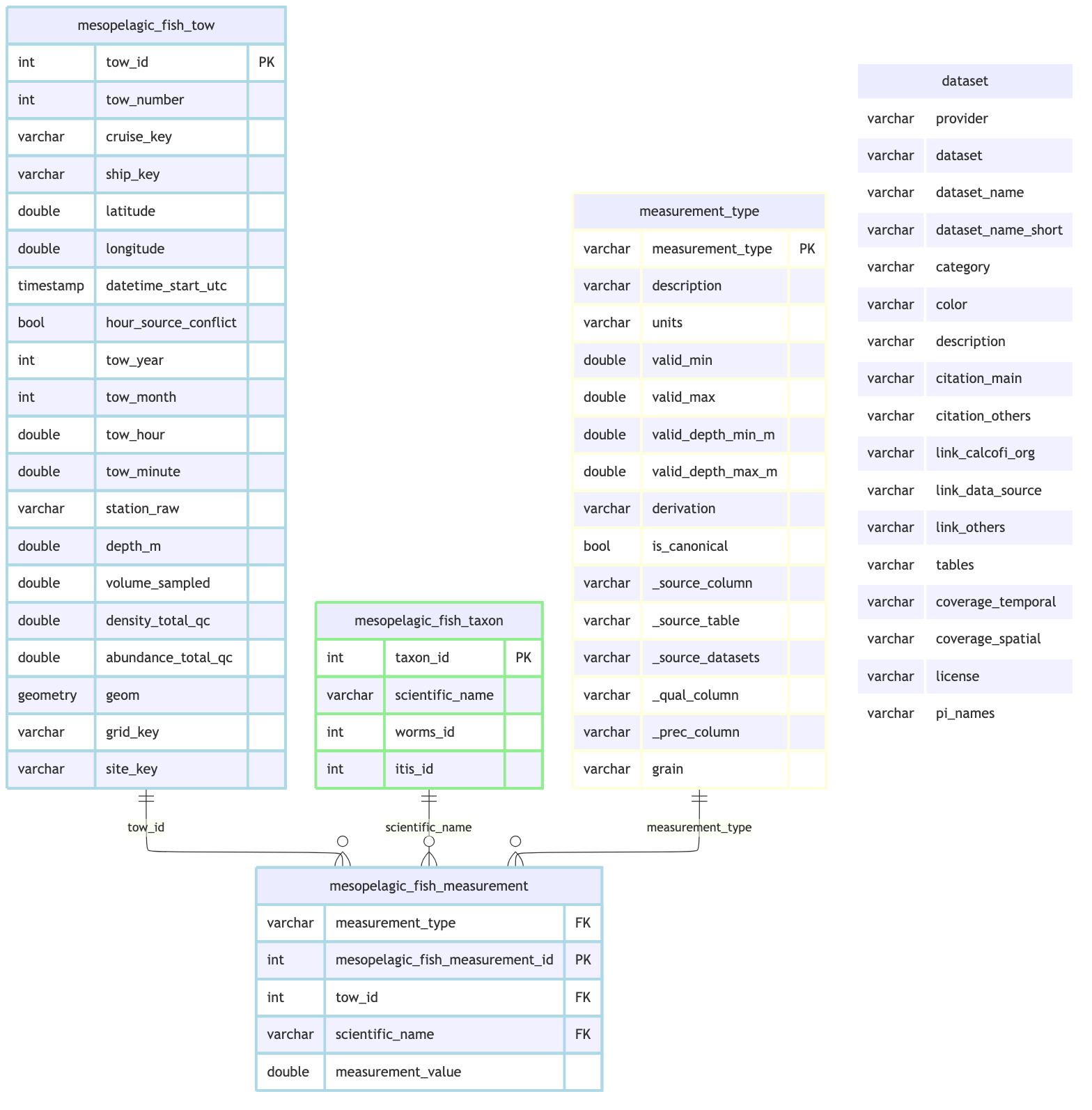
```{r}
#| label: schema
fish_rels <- list(
  primary_keys = list(
    mesopelagic_fish_tow         = "tow_id",
    mesopelagic_fish_taxon       = "taxon_id",
    mesopelagic_fish_measurement = "mesopelagic_fish_measurement_id",
    measurement_type             = "measurement_type"),
  foreign_keys = list(
    list(table = "mesopelagic_fish_measurement", column = "tow_id",
         ref_table = "mesopelagic_fish_tow", ref_column = "tow_id"),
    list(table = "mesopelagic_fish_measurement", column = "scientific_name",
         ref_table = "mesopelagic_fish_taxon", ref_column = "scientific_name"),
    list(table = "mesopelagic_fish_measurement", column = "measurement_type",
         ref_table = "measurement_type", ref_column = "measurement_type")))

cc_erd(
  con,
  tables = c("mesopelagic_fish_tow", "mesopelagic_fish_taxon",
             "mesopelagic_fish_measurement", "measurement_type", "dataset"),
  rels   = fish_rels,
  colors = list(
    lightblue   = c("mesopelagic_fish_tow", "mesopelagic_fish_measurement"),
    lightgreen  = "mesopelagic_fish_taxon",
    lightyellow = "measurement_type",
    white       = "dataset"))
build_relationships_json(
  rels = fish_rels, output_dir = dir_parquet, provider = provider, dataset = dataset)
```
## Emit Core Tables
Project this dataset into the shared consolidated core model
(`design_env-bio-consolidation.md`) — a
self-leaf `tow` sample whose `obs` headline is the per-species count.
`datetime_start_utc` is real (Q03 resolved), so `sample.datetime` is populated
rather than NULL, and `taxon_key` resolves through `dataset_taxon` from
`mesopelagic_fish_taxon` at release time.
```{r}
#| label: emit_core
ds_key <- "sio_mesopelagic-fish"
# filter the crosswalk to THIS dataset -- an unfiltered read leaks other datasets'
# taxa into this shard (the retired emit_core_tables() wrapper filtered internally)
mt_taxon <- read_csv(here("metadata/measurement_taxon.csv"),
                     col_types = cols(worms_id = "i", itis_id = "i",
                                      bin_value = "d", .default = "c")) |>
  filter(dataset_key == ds_key)
tx_over  <- read_csv(here("metadata/taxon_override.csv"), show_col_types = FALSE)

# This projection lives here, in the notebook that owns the dataset, not in a
# switch(dataset_key, ...) arm inside calcofi4db. The reusable SHAPES stay in the
# package (sample_arm_self / compat_measurement_sql), so this is a declaration.

# the vocabulary is DECLARED here and RESOLVED by the package (taxon plan D1,
# calcofi4db >= 3.29.0). `ds_taxa_code` IS the verbatim spreadsheet header (the
# source has no local code), so `obs` joins dataset_taxon on the name it stores
# on the measurement row -- which is exactly why the " sp." suffix must NOT be
# cleaned out of the code: rewriting it would orphan every observation of those
# six taxa. The lookup name is cleaned instead, inside the xref name fallback.
d_vocab <- dbGetQuery(con, "
  SELECT scientific_name           AS ds_taxa_code,
         scientific_name           AS ds_scientific_name,
         CAST(worms_id AS INTEGER) AS worms_id
  FROM mesopelagic_fish_taxon ORDER BY taxon_id")
n_staged <- append_dataset_taxon(con, ds_key, d_vocab)

# cross-reference: resolve each taxon against BOTH authorities (cached in
# metadata/taxon_xref.csv, so a re-run costs no API calls). This fills the
# `worms_id` COLUMN on itis:-keyed taxa without touching their key — a consumer
# joining on worms_id used to match ZERO rows for every seabird and marine
# mammal — backfills `itis_id` the other way, replaces an id its authority has
# deprecated so the key is always an accepted id, and fetches the real
# `taxonomic_status` with the date it was checked. Must precede the lineage
# fetch, which should ask about the accepted id, not the deprecated one.
ensure_taxon_xref(con, mt_taxon, tx_over,
                  cache_csv = here("metadata/taxon_xref.csv"))

# lineage: fetch each taxon's WoRMS/ITIS classification (cached in
# metadata/taxon_lineage.csv, so a re-run costs no API calls) and stage it as the
# `taxon` hierarchy build_taxon_reference() reads. Without it a crosswalk- or
# vocabulary-resolved taxon reaches the release with a key and a name and NOTHING
# else — no rank, no parent_taxon_key, no classification — so hierarchy rollups
# ("all Decapoda") silently match nothing and no error is raised anywhere.
ensure_taxon_lineage(con, mt_taxon, tx_over,
                     cache_csv = here("metadata/taxon_lineage.csv"))
n_taxon    <- build_taxon_reference(con, mt_taxon, tx_over)
n_ds_taxon <- resolve_dataset_taxon(con, mt_taxon, tx_over)

# the ingest asserts its own crosswalk (D6): every name the measurements use is
# in the vocabulary and every staged row keys an authority id. Halts on any
# finding.
obs_codes <- dbGetQuery(con,
  "SELECT DISTINCT scientific_name AS c FROM mesopelagic_fish_measurement
   WHERE scientific_name IS NOT NULL")$c
chk_taxon <- check_dataset_taxon(con, ds_key, codes = obs_codes)
cat(glue("vocabulary: {n_staged} species staged; taxon {n_taxon}, ",
         "dataset_taxon {n_ds_taxon}"), "\n")
append_sample(con, sample_arm_self(
  ds_key, "mesopelagic_fish_tow", "tow_id", "tow", site_expr = "site_key",
  depth_min = "0::DOUBLE", depth_max = "depth_m"))

append_obs(con, glue("
  SELECT 'bio', '{ds_key}', {ns_key(ds_key, 'tow', 'tw.tow_id')},
         tw.grid_key, tw.cruise_key, tw.latitude, tw.longitude,
         CAST(tw.datetime_start_utc AS TIMESTAMP), 0::DOUBLE, tw.depth_m,
         dt.taxon_key, NULL::VARCHAR, m.measurement_type, m.measurement_value,
         NULL::VARCHAR, NULL::DOUBLE
  FROM mesopelagic_fish_measurement m JOIN mesopelagic_fish_tow tw USING (tow_id)
  LEFT JOIN dataset_taxon dt ON dt.dataset_key = '{ds_key}'
                            AND dt.ds_taxa_code = m.scientific_name"))

# NOTE: no sample_measurement arm. This dataset never had one --
# dataset (.sample_measurement_arm_sql covers only calcofi_bottle and
# swfsc_ichthyo), and its parquet has never contained the table. Adding one here
# would be inventing data, not migrating it.

core <- list(
  sample = dbGetQuery(con, "SELECT COUNT(*) FROM sample")[[1]],
  obs    = dbGetQuery(con, "SELECT COUNT(*) FROM obs")[[1]],
  taxon  = n_taxon, dataset_taxon = n_ds_taxon)
cat(glue(
  "core projection — sample={core$sample %||% 0} obs={core$obs %||% 0} ",
  "taxon={core$taxon %||% 0} dataset_taxon={core$dataset_taxon %||% 0}\n"))
n_obs <- dbGetQuery(con, "SELECT COUNT(*) FROM obs")[[1]]
n_exp <- dbGetQuery(con,
  "SELECT COUNT(*) FROM mesopelagic_fish_measurement m
   JOIN mesopelagic_fish_tow t USING (tow_id)")[[1]]
n_dt  <- dbGetQuery(con, "SELECT COUNT(*) FROM sample WHERE datetime IS NOT NULL")[[1]]
stopifnot(
  "obs must be one row per measurement" = n_obs == n_exp,
  "sample.datetime must be populated (Q03)"          = n_dt > 0)
cat(glue("obs parity: {format(n_obs, big.mark=',')} rows; ",
         "{n_dt} sample rows with a real datetime"), "\n")
stopifnot(
  "every obs.sample_key must resolve in sample" =
    dbGetQuery(con, "SELECT COUNT(*) FROM obs o LEFT JOIN sample s USING (sample_key)
                     WHERE s.sample_key IS NULL")[[1]] == 0)
# serve the retired per-dataset table names as VIEWs over the core, so
# in-notebook consumers and ad-hoc queries keep working against the old names
# (exact for every column the core models, lossy for the rest)
invisible(dbExecute(con, "DROP TABLE IF EXISTS mesopelagic_fish_measurement_src"))
invisible(dbExecute(con, "ALTER TABLE mesopelagic_fish_measurement RENAME TO mesopelagic_fish_measurement_src"))
invisible(dbExecute(con, glue(
  "CREATE OR REPLACE VIEW mesopelagic_fish_measurement AS
   {compat_measurement_sql(ds_key, 'tow', 'tow_id', 'measurement_id')}")))
cat(glue("compat view mesopelagic_fish_measurement over obs: ",
         "{dbGetQuery(con, 'SELECT COUNT(*) FROM mesopelagic_fish_measurement')[[1]]} rows"), "\n")
```
## Validate and Write Outputs
```{r}
#| label: finalize
results <- validate_for_release(con, checks = "all", strict = FALSE)
cat("Validation:", ifelse(results$passed, "PASSED", "FAILED"), "\n")
if (length(results$errors) > 0)
  cat("Errors:\n", paste("-", results$errors, collapse = "\n"), "\n")
# NOTE: `FAILED` here is expected and non-blocking (strict = FALSE). The
# remaining errors are NULL authority ids on mesopelagic_fish_taxon: species
# WoRMS or ITIS does not carry. They are reported by name above so a curator can
# act on them; nothing downstream requires a non-NULL worms_id (obs.taxon_key
# falls back to a dataset-local key via resolve_dataset_taxon()).

dir_create(dir_parquet)
tbls_out <- core_output_tables(con, extra = c("measurement_type", "dataset"))
write_parquet_outputs(
  con        = con,
  output_dir = dir_parquet,
  tables     = tbls_out,
  sort_by    = list(obs = c("grid_key", "measurement_type")),
  strip_provenance = FALSE)
build_relationships_json(
  rels = core_relationships(tbls_out), output_dir = dir_parquet,
  provider = provider, dataset = dataset)
d_tbls_rd <- read_csv(here("metadata/sio/mesopelagic-fish/tbls_redefine.csv"))
d_flds_rd <- read_csv(here("metadata/sio/mesopelagic-fish/flds_redefine.csv"))
build_metadata_json(
  con = con, d_tbls_rd = d_tbls_rd, d_flds_rd = d_flds_rd,
  metadata_derived_csv = c(here("metadata/core_dictionary.csv"),
                           here("metadata/sio/mesopelagic-fish/metadata_derived.csv")),
  output_dir = dir_parquet,
  tables     = tbls_out,
  set_comments = TRUE, provider = provider, dataset = dataset,
  workflow_url = cc$workflow_url, tables_owned = tables_owned)
sync_to_gcs(local_dir = dir_stage, sidecar_dir = dir_parquet, gcs_prefix = glue("ingest/{dir_label}"), bucket = "calcofi-db")
```
## Questions for Data Providers
```{r}
#| label: provider-questions
# one validated read + render for every ingest: the vocabulary and the column
# order live in calcofi4db, not in 16 hand-written factor() calls
questions_datatable(
  here(cc$questions_file),
  caption = "Questions for the SIO mesopelagic fish data providers (ranked)")
```
```{r}
#| label: cleanup
close_duckdb(con); cat(glue("Parquet outputs written to: {dir_parquet}"), "\n")
```