---
title: "Ingest CCE-LTER Dissolved Iron"
calcofi:
target_name: ingest_cce_lter_iron
workflow_type: ingest
dependency:
- ingest_swfsc_ichthyo
output: data/parquet/cce-lter_iron/manifest.json
provider: cce-lter
dataset: iron
workflow_url: https://calcofi.io/workflows/ingest_cce-lter_iron.html
questions_file: metadata/cce-lter/iron/questions.csv
dataset_meta:
dataset_name: CCE-LTER Dissolved Iron (CalCOFI Cruises)
# display trio, read by the release `dataset` table and the consumer apps
# (calcofi4db >= 3.15.0) — see NEWS for why these left the apps' own
# hardcoded maps. Moved here from metadata/cce-lter/iron/dataset_meta.yml
# on 2026-09-19: that sidecar held both halves while this was still an
# un-ingested "holding" (WS-R1 2026-09-05 CalOOS intake); now that a
# notebook exists, the structural keys belong here per
# check_dataset_meta_split().
dataset_name_short: "Dissolved iron"
category: "Nutrients & Chemistry"
color: "#b8860b"
# publishes the consolidated core: the source shape is wrangled in the
# notebook and projected into the shared core tables.
tables_owned:
- {table: sample, shared: true, note: "core event dimension (own sample grain, no cast/bottle FK available in the source)"}
- {table: obs, shared: true, note: "core observation headline (env realm; dissolved_iron only, see Hold-out below)"}
- {table: measurement_type, shared: true, note: "shared registry across datasets"}
erd:
color: "#f0e0c0"
editor_options:
chunk_output_type: console
---
## Overview
**Source**: EDI package `knb-lter-cce.21.3` (Barbeau), entity *DissolvedIron* —
171 rows, 13 columns per the package's EML (`libs/download_iron.R`), Nov. 2002 -
July 2004, completed/archived. This is the "first solo run" ingest tracked by
[CalCOFI/workflows#82](https://github.com/CalCOFI/workflows/issues/82); model
reference is `ingest_cce-lter_picoplankton-bacteria.qmd`, the closest existing
shape (a CCE-LTER DataZoo/EDI export with no native cast/bottle FK, its own
`study_name`-derived cruise key, own position/depth/time per row).
- **Provider**: `cce-lter` (matches `euphausiids`/`picoplankton-bacteria`/
`zoodb`/`zooscan`)
- **Grain**: one row per sample event; in this revision every row is a surface
(0 m) **pole** sample (`Iron Sampling Equipment = p`, 170/170), not a Niskin
bottle or a profile. There is no cast/bottle number in the source, so this dataset mints its **own**
`sample` arm rather than matching into `calcofi_bottle`/`casts` (Pattern A,
like picoplankton-bacteria — not Pattern B/DIC, which has cast/bottle FKs to
match against).
- **Realm**: `env` — this is chemistry (dissolved iron), not an occurrence of
a taxon. `obs.taxon_key` stays NULL
throughout, unlike picoplankton-bacteria's `bio` realm.
- **Hold-out (decision B6, Ben Best, 2026-10-01)**: only `dissolved_iron` is
emitted. `chl_response_to_fe` is **held out** of `sample`/`obs` until the
provider answers Q01 (is it a unitless treatment:control ratio, a
concentration or a code? `status = open`, `priority = blocker`): its EML
`measurementScale` is `nominal`, so publishing it as a measurement would put
an uninterpreted number into `obs_env`. `total_iron` is held out because the
revision has **no real value** (170 of 170 rows are the `-999` sentinel), and a
measurement type with no data does not belong in the registry or the catalog.
Neither type is in `metadata/measurement_type.csv`; both source columns stay
in the staging table `iron_sample` (counted in the Pivot chunk) so
they can be emitted the day Q01 is answered or a revision populates Total Fe.
- **Sample key**: `sample_key = cce-lter_iron:bottle:{study_name}-{index_number}`,
built from the source's own (`studyName`, `Index Number`) pair, which is
asserted unique below — not from row position, so a republished revision that
inserts or reorders a row cannot shift a published key. `sample_type = bottle`
follows the family's convention for a discrete water sample (a pole sample is
surface water taken by hand into a bottle); consumers always filter by
`dataset_key`, and the equipment code is kept in `iron_sampling_equipment`.
- **No cast matching**: pole samples are taken from the ship's side, not from a
CTD/bottle cast, so there is no cast to attach to
(`match_by_site_datetime()` / `match_nearest_by_depth()` do not apply, unlike
`calcofi_dic`). A `parent_sample_key` to the nearest cast could be added later.
- **Scope decision**: no bounding-box filter applied — source is already
scoped to CalCOFI/CCE cruises by the provider (same reasoning as
picoplankton-bacteria).
```{mermaid}
graph LR
  A[EDI knb-lter-cce.21.3<br/>DissolvedIron, 171 rows] --> B[rename + type-cast]
  B --> C[iron_sample<br/>position + depth, one row per sample]
  B --> D[iron_measurement<br/>long format: dissolved_iron only]
  C -.study_name -> cruise_key.-> E[(shared refs)]
  D -.sample_id.-> C
  C --> F[[core: sample]]
  D --> G[[core: obs, realm=env]]
```
## Setup
```{r}
#| label: setup
devtools::load_all(here::here("../calcofi4db"))
devtools::load_all(here::here("../calcofi4r"))
librarian::shelf(
  CalCOFI/calcofi4db, CalCOFI/calcofi4r,
  DBI, dplyr, DT, fs, glue, here, htmltools, janitor, jsonlite, knitr,
  lubridate, purrr, readr, sf, stringr, tibble, tidyr, units,
  quiet = T)
options(readr.show_col_types = F)
options(DT.options = list(scrollX = TRUE))

source(here("libs/ingest.R"))
cc <- read_calcofi_meta(here("ingest_cce-lter_iron.qmd"))
provider <- cc$provider
dataset <- cc$dataset
dataset_name <- cc$dataset_meta$dataset_name
tables_owned <- cc$tables_owned
dir_label <- glue("{provider}_{dataset}")
dir_parquet <- here(glue("data/parquet/{dir_label}"))
dir_stage <- cc_stage_path("parquet", dir_label, create = TRUE)
db_path <- here(glue("data/wrangling/{dir_label}.duckdb"))
meas_type_csv <- here("metadata/measurement_type.csv")
# dissolved_iron was registered directly into the registry during
# /generate-metadata (metadata/measurement_type.csv), not here at ingest time —
# this notebook reads and uses it, it does not (re-)register it. total_iron and
# chl_response_to_fe are deliberately NOT registered (held out, see Overview).
d_meas_type <- read_measurement_type(meas_type_csv)
stopifnot(
  "dissolved_iron must be pre-registered" =
    "dissolved_iron" %in% d_meas_type$measurement_type,
  "held-out types must stay unregistered until Q01 / a populated Total Fe" =
    !any(c("total_iron", "chl_response_to_fe") %in% d_meas_type$measurement_type))

if (overwrite) {
  if (file_exists(db_path)) file_delete(db_path)
  if (file_exists(paste0(db_path, ".wal"))) file_delete(paste0(db_path, ".wal"))
  if (dir_exists(paste0(db_path, ".tmp"))) dir_delete(paste0(db_path, ".tmp"))
}
dir_create(dirname(db_path))
con <- get_duckdb_con(db_path)
load_duckdb_extension(con, "spatial")
dbWriteTable(con, "measurement_type", d_meas_type, overwrite = TRUE)
```
## Read Source Data
Fetched reproducibly from EDI by `libs/download_iron.R` (package
`knb-lter-cce.21.3`, entity *DissolvedIron*), pinned to revision 3 with its
md5 asserted, so a republished package fails loudly instead of silently
re-shaping the ingest. Unlike picoplankton-bacteria's Datazoo table, this
entity is not gated behind a login/data-agreement form, so it is pulled
directly from EDI — same route as `download_euphausiids()`. Columns are
renamed per `metadata/cce-lter/iron/flds_redefine.csv`.
```{r}
#| label: read-source
source(here("libs/download_iron.R"))
iron_csv <- download_iron(
  path_expand(glue("{dir_data}/{provider}/{dataset}")),
  overwrite = overwrite_all)
stopifnot("iron data.csv not found" = file_exists(iron_csv))

sync_to_gcs(
  local_dir  = path_dir(iron_csv),
  gcs_prefix = glue("archive/{provider}/{dataset}"),
  bucket     = "calcofi-files-public",
  exclude    = c(".DS_Store", "*.tmp", "*.gdoc"))
d_raw <- read_csv(iron_csv, col_types = cols(.default = "c"))
cat(glue("Read {format(nrow(d_raw), big.mark=',')} rows, {ncol(d_raw)} columns"), "\n")
# confirmed against the real file (2026-09-19): 171 rows, 13 columns, matching
# the EML's 13 attributes -- DataZoo's summary page figure of 12 columns was
# stale/wrong and is not asserted here.
stopifnot(
  "expected 171 rows x 13 columns per the real source file" =
    nrow(d_raw) == 171 && ncol(d_raw) == 13)
```
## Clean, Type-Cast
Canonical names from `metadata/cce-lter/iron/flds_redefine.csv`. `Event
Number` is the source's own provenance counter (unpopulated here), kept but not
used as a key. `studyName` + `Index Number` is the natural sample key (asserted
unique below); `sample_id` is only the integer pivot FK between `iron_sample`
and `iron_measurement`, assigned in that key's order so it is deterministic.
Only the Dissolved Fe column is pivoted to long format below; Total Fe and
Chla response to Fe+ are held out of the emitted tables (Overview). Real source headers carry unit
suffixes the EML's `attributeName` elements omit (`Latitude (º)`,
`Longitude (º)`, `Depth (m)`, `Dissolved Fe (nM/L)`, `Total Fe (nM/L)`) —
confirmed against the real file (2026-09-19) and reflected in the column
references below and in `flds_redefine.csv`.
`Datetime PST` is converted to UTC as a **fixed UTC-8 offset**, not adjusted
for daylight saving — the column is explicitly labeled PST rather than
"Pacific Time" or "local time", which is the reading proposed to the provider
in `questions.csv` Q02 (`status = proposed`, awaiting confirmation). If that
reading is wrong, every `datetime_start_utc` value shifts by up to an hour for
rows sampled during PDT months — re-derive from `Datetime PST` rather than
patching `datetime_start_utc` directly if Q02 comes back answered differently.
One source row (line 80 of the real CSV) is entirely blank apart from
`studyName` and is dropped explicitly below, with a reported count, rather
than letting the resulting NAs flow into `add_point_geom()` /
`assign_grid_key()` downstream. Separately, `-999` is used throughout this
table as an undocumented missing-value sentinel (`questions.csv` Q06 — the
EML itself declares `missingValueCode = NULL`/blank for every attribute) and
is converted to `NA` before casting, for the same reason
`check_measurement_bounds()`/`drop_out_of_bounds()` exist: an unconverted
sentinel reaching `obs.measurement_value` as if it were a real reading is
exactly the failure mode behind the historical `calcofi_mets.sw_ph` `-99`
incident (`RUNBOOK.md`).
```{r}
#| label: clean-cast
# one fully-blank row (source keeps only studyName; every other field is
# empty) — verified 2026-09-19 to be exactly 1 row (CSV line 80,
# `2002-11-10-C-32NM,,,,,,,,,,,,`)
d_raw <- d_raw |>
  mutate(.blank = if_all(-studyName, ~ is.na(.x) | .x == ""))
n_blank <- sum(d_raw$.blank)
d_raw <- d_raw |> filter(!.blank) |> select(-.blank)
cat(glue("Dropped {n_blank} fully-blank row(s) (studyName only, no measurements)"), "\n")
# -999 is an undocumented missing-value sentinel (see Q06 above). Converted
# to NA before casting for every column verified to carry it: event_number
# (170/171 rows), total_fe_nmol_l (170/171 rows — zero real values in this
# revision), and chl_response_to_fe (148/171 rows).
na_sentinel <- function(x) if_else(x == "-999", NA_character_, x)

d_clean <- d_raw |>
  transmute(
    study_name    = studyName,
    event_number  = suppressWarnings(as.numeric(na_sentinel(`Event Number`))),
    index_number  = suppressWarnings(as.integer(`Index Number`)),
    # fixed UTC-8: see Q02 above — the source column is literally "Datetime PST"
    datetime_start_utc = suppressWarnings(as_datetime(`Datetime PST`)) + hours(8),
    latitude      = suppressWarnings(as.numeric(`Latitude (º)`)),
    longitude     = suppressWarnings(as.numeric(`Longitude (º)`)),
    line          = suppressWarnings(as.numeric(Line)),
    station       = suppressWarnings(as.numeric(Station)),
    depth_m       = suppressWarnings(as.numeric(`Depth (m)`)),
    iron_sampling_equipment = `Iron Sampling Equipment`,
    dissolved_fe_nmol_l = suppressWarnings(as.numeric(na_sentinel(`Dissolved Fe (nM/L)`))),
    total_fe_nmol_l     = suppressWarnings(as.numeric(na_sentinel(`Total Fe (nM/L)`))),
    chl_response_to_fe  = suppressWarnings(as.numeric(na_sentinel(`Chla response to Fe+`)))) |>
  mutate(
    site_key = if_else(
      is.na(line) | is.na(station), NA_character_,
      sprintf("%05.1f %05.1f", line, station)),
    # natural, stable sample key (study + the source's per-cruise counter);
    # '-' not ':' so the key's own colon-delimited id stays one token
    sample_key_id = paste0(study_name, "-", index_number)) |>
  arrange(study_name, index_number) |>
  mutate(sample_id = row_number())

stopifnot(
  "index_number must parse for every row" = !anyNA(d_clean$index_number),
  "(study_name, index_number) must be unique: it is the sample key" =
    !anyDuplicated(d_clean$sample_key_id))
cat(glue("sample_key_id unique over {nrow(d_clean)} rows ",
         "({n_distinct(d_clean$study_name)} cruises)"), "\n")
n_all <- nrow(d_clean)
cat(glue("{format(n_all, big.mark=',')} rows read, no bounding-box filter applied ",
         "(source pre-scoped to CalCOFI/CCE cruises)"), "\n")
n_equip_other <- sum(!is.na(d_clean$iron_sampling_equipment) &
                       d_clean$iron_sampling_equipment != "p")
cat(glue("Iron Sampling Equipment codes other than documented 'p': {n_equip_other} row(s) ",
         "— if > 0, resolve against Q03 before publishing (0 expected — Q03 resolved 2026-09-19)"), "\n")
dbWriteTable(con, "iron_sample", d_clean, overwrite = TRUE)
```
## Pivot Measurements to Long Format
Only `dissolved_iron` is pivoted to `iron_measurement` (the table that is
projected into `obs`). `chl_response_to_fe` (Q01 open/blocker: units and meaning
unconfirmed) and `total_iron` (no real values) are **held out**: their
non-NULL counts are reported below, their columns stay in `iron_sample`
(a staging table that is not released), and neither is registered in
`metadata/measurement_type.csv` nor emitted. To release one, answer Q01 /
find a populated Total Fe, register the type with `register_measurement_types()`
+ `declare_measurement_fields()` (a `category`), add it to `iron_meas_map` and
revisit its bounds.
```{r}
#| label: pivot-long
iron_meas_map <- tribble(
  ~measurement_type,     ~value_col,
  "dissolved_iron",       "dissolved_fe_nmol_l")

sql_parts <- purrr::pmap_chr(iron_meas_map, function(measurement_type, value_col) {
  glue(
    "SELECT sample_id, '{measurement_type}' AS measurement_type,
     CAST({value_col} AS DOUBLE) AS measurement_value
     FROM iron_sample WHERE {value_col} IS NOT NULL")
})

sql_create <- glue(
  "CREATE OR REPLACE TABLE iron_measurement AS
   SELECT ROW_NUMBER() OVER (ORDER BY sample_id, measurement_type) AS measurement_id, *
   FROM (
     {paste(sql_parts, collapse = '\nUNION ALL\n')}
   ) sub")
dbExecute(con, sql_create)
n_meas <- dbGetQuery(con, "SELECT COUNT(*) FROM iron_measurement")[[1]]
cat(glue("iron_measurement: {format(n_meas, big.mark=',')} rows"), "\n")
dbGetQuery(con, "SELECT measurement_type, COUNT(*) n FROM iron_measurement GROUP BY 1 ORDER BY 1") |>
  datatable(caption = "Rows per measurement_type")
# held-out columns: report, then keep them in iron_sample only
n_held <- dbGetQuery(con, "
  SELECT COUNT(total_fe_nmol_l) AS total_iron_n,
         COUNT(chl_response_to_fe) AS chl_response_to_fe_n
  FROM iron_sample")
cat(glue("held out (not emitted): total_iron {n_held$total_iron_n} real value(s), ",
         "chl_response_to_fe {n_held$chl_response_to_fe_n} value(s) pending Q01"), "\n")
stopifnot("total_iron was expected to have no real value in revision 3" =
            n_held$total_iron_n == 0)

# dissolved iron at/near the minimum: the 0.05 floor may be a detection limit
# (Q04) — report, do not interpret
d_fe <- dbGetQuery(con, "SELECT measurement_value v FROM iron_measurement")$v
cat(glue("dissolved_iron: min {min(d_fe)} nmol/L; n at the minimum = ",
         "{sum(d_fe == min(d_fe))}, n within 2x of the minimum = ",
         "{sum(d_fe <= 2 * min(d_fe))} of {length(d_fe)} (Q04: is the floor a ",
         "detection limit?)"), "\n")
```
## Resolve Ship and Cruise Keys
Same approach as `ingest_cce-lter_picoplankton-bacteria.qmd`: `study_name` is
the only cruise identifier in this source (no separate `Cruise` short-code
column here), and its trailing token is the ship code.
The extraction regex below is copied from the picoplankton-bacteria
notebook's verified pattern (`2004-11-02-C-33RR` -> `33RR`). Confirmed
2026-09-19 against all 6 distinct `study_name` values in the real file (e.g.
`2002-11-10-C-32NM`) — the format matches structurally. `derive_cruise_key_on_casts()`
resolves every row by date span (see the rendered `key_stats`).
```{r}
#| label: resolve-keys
load_prior_tables(
  con, parquet_dir = cc_stage_path("parquet", "swfsc_ichthyo"),
  tables = c("ship", "cruise", "grid"), geom_tables = c("grid"), as_view = TRUE)
dbExecute(con, "
  ALTER TABLE iron_sample ADD COLUMN IF NOT EXISTS ship_code VARCHAR")
dbExecute(con, "
  UPDATE iron_sample
  SET ship_code = regexp_extract(study_name, '[0-9A-Z]+$')")
dbExecute(con, "
  ALTER TABLE iron_sample ADD COLUMN IF NOT EXISTS cruise_ym VARCHAR")
dbExecute(con, "
  UPDATE iron_sample
  SET cruise_ym = regexp_replace(study_name, '^(\\d{4})-(\\d{2}).*$', '\\1\\2')")
cruise_key_result <- derive_cruise_key_on_casts(
  con, table_name = "iron_sample", datetime_col = "datetime_start_utc",
  cruise_ym_col = "cruise_ym")
cruise_key_result$key_stats |>
  datatable(caption = "cruise_key resolution: span > source designation > month")
n_ck <- dbGetQuery(con, "SELECT COUNT(*) FROM iron_sample WHERE cruise_key IS NOT NULL")[[1]]
n_all <- dbGetQuery(con, "SELECT COUNT(*) FROM iron_sample")[[1]]
cat(glue("cruise_key match: {n_ck}/{n_all} ({round(100*n_ck/n_all,1)}%)"), "\n")
```
## Add Spatial
```{r}
#| label: spatial
add_point_geom(con, "iron_sample", lon_col = "longitude", lat_col = "latitude")
assign_grid_key(con, "iron_sample") |> datatable(caption = "Grid assignment")
```
## Load Dataset Metadata
```{r}
#| label: load-dataset-metadata
d_dataset <- ingest_yaml_to_dataset_df(read_ingest_yaml(here()))
dbWriteTable(con, "dataset", d_dataset, overwrite = TRUE)
cat(glue("dataset: {nrow(d_dataset)} datasets registered"), "\n")
```
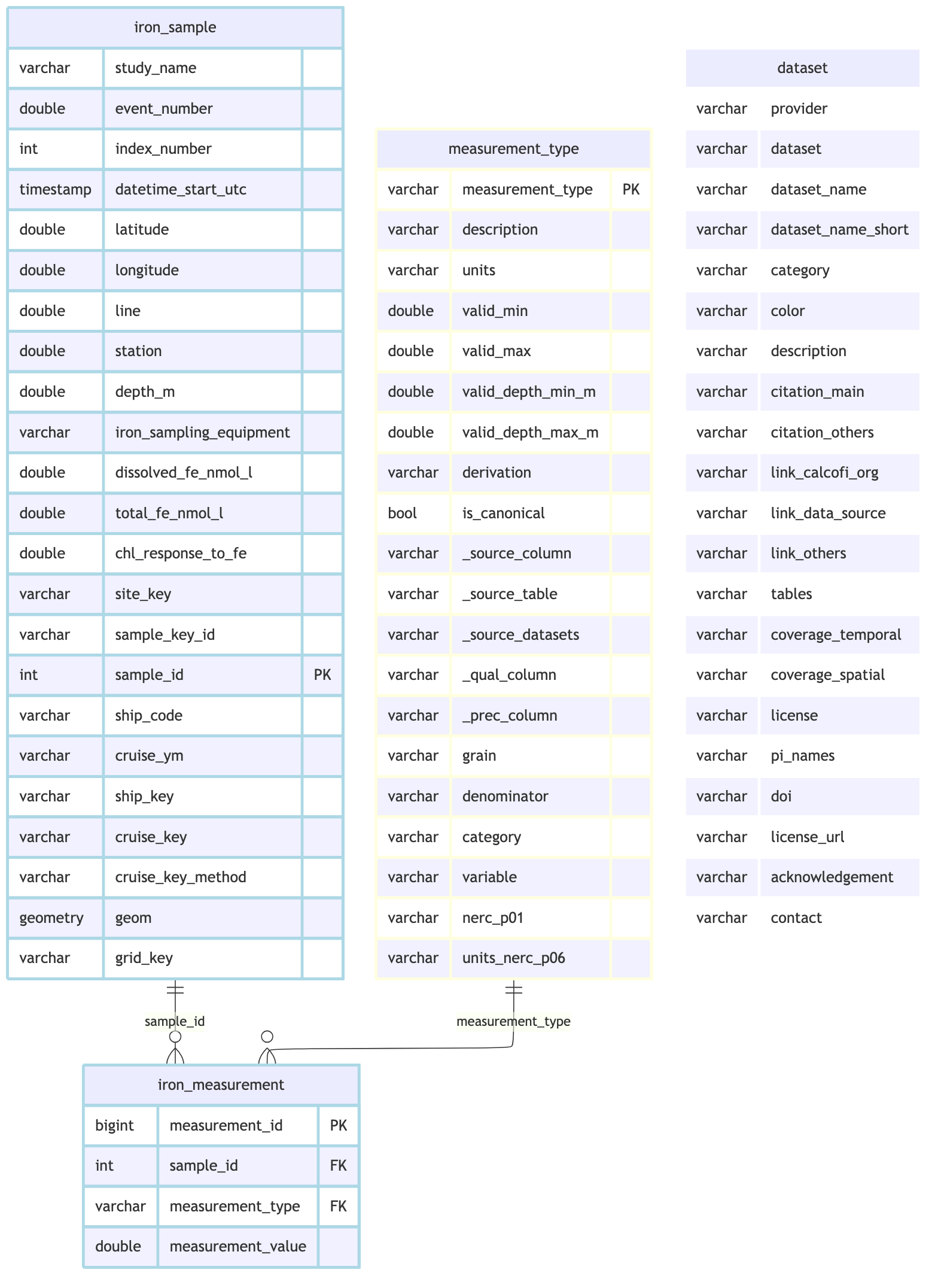
## Schema Documentation
```{r}
#| label: schema
iron_rels <- list(
  primary_keys = list(
    iron_sample      = "sample_id",
    iron_measurement = "measurement_id",
    measurement_type = "measurement_type"),
  foreign_keys = list(
    list(table = "iron_measurement", column = "sample_id",
         ref_table = "iron_sample", ref_column = "sample_id"),
    list(table = "iron_measurement", column = "measurement_type",
         ref_table = "measurement_type", ref_column = "measurement_type")))

cc_erd(
  con, tables = c("iron_sample", "iron_measurement", "measurement_type", "dataset"),
  rels = iron_rels,
  colors = list(lightblue = c("iron_sample", "iron_measurement"),
                lightyellow = "measurement_type", white = "dataset"))
build_relationships_json(
  rels = iron_rels, output_dir = dir_parquet, provider = provider, dataset = dataset)
```
## Check Declared Bounds
Not optional (RUNBOOK.md §3b) and an explicit completion criterion of issue
#82. The one emitted type, `dissolved_iron`, carries `valid_min = 0`
(registered during `/generate-metadata`); a one-sided bound counts as declared
for `check_measurement_bounds()`, so it reports `ok`. Its `valid_max` is **not
declared**: `questions.csv` Q05 proposes 50 nmol/L to Kathy — a generous
ceiling (~6x the observed maximum of 8.2 nmol/L), never the observed range
itself — and it stays `proposed` until she agrees. The held-out types
(`total_iron`, `chl_response_to_fe`) are not registered, so they have no bound
to check; a bound for `chl_response_to_fe` is meaningless until Q01 says what
the number is.
```{r}
#| label: bounds-check
bounds_pre <- check_measurement_bounds(con, "iron_measurement", mt = d_meas_type)
bounds_datatable(bounds_pre)
bounds_pre |> filter(status != "ok") |> select(measurement_type, status, finding) |>
  datatable(caption = "Bounds findings (empty = every emitted type is ok) — dissolved_iron: valid_min=0 declared, valid_max proposed in Q05 but not declared")
```
```{r}
#| label: bounds-enforce
# dissolved_iron carries a declared valid_min = 0 floor; its valid_max awaits Q05
oob_tally <- drop_out_of_bounds(con, "iron_measurement", mt = d_meas_type)
cat(glue(
  "out-of-range rows removed: {format(sum(oob_tally$n_bad %||% 0), big.mark=',')} ",
  "(dissolved_iron < 0 is enforceable today; the upper bound awaits Q05)"), "\n")
bounds_post <- check_measurement_bounds(
  con, "iron_measurement", mt = d_meas_type, include_undeclared = FALSE)
stopifnot(
  "iron_measurement must hold no value outside a DECLARED bound" =
    sum(bounds_post$status == "out_of_range") == 0)
```
## Validate
```{r}
#| label: validate
results <- validate_for_release(con, checks = "all", strict = FALSE)
cat("Validation:", ifelse(results$passed, "PASSED", "FAILED"), "\n")
if (length(results$errors) > 0)
  cat("Errors:\n", paste("-", results$errors, collapse = "\n"), "\n")
if (length(results$warnings) > 0)
  cat("Warnings:\n", paste("-", results$warnings, collapse = "\n"), "\n")

# cruise_key resolution is reported (and gated at release by
# check_cruise_key_integrity()); sample_id is the pivot FK, so it is checked here
n_dup <- dbGetQuery(con,
  "SELECT COUNT(*) FROM (SELECT sample_id, COUNT(*) n FROM iron_sample GROUP BY sample_id HAVING COUNT(*)>1)")[[1]]
cat(glue("iron_sample sample_id duplicates: {n_dup}"), "\n")
n_orphan <- dbGetQuery(con,
  "SELECT COUNT(*) FROM iron_measurement m
   LEFT JOIN iron_sample s ON m.sample_id = s.sample_id
   WHERE s.sample_id IS NULL")[[1]]
cat(glue("Orphan measurements (no matching sample): {n_orphan}"), "\n")
n_orphan_type <- dbGetQuery(con,
  "SELECT COUNT(*) FROM iron_measurement m
   WHERE m.measurement_type NOT IN (SELECT measurement_type FROM measurement_type)")[[1]]
cat(glue("Orphan measurement_types (not registered): {n_orphan_type}"), "\n")
```
## Enforce Column Types
```{r}
#| label: enforce-types
enforce_column_types(con)
```
## Data Preview
```{r}
#| label: preview
cols <- dbGetQuery(con,
  "SELECT column_name FROM information_schema.columns
   WHERE table_name='iron_sample' AND data_type NOT LIKE 'GEOMETRY%'")$column_name
dbGetQuery(con, glue("SELECT {paste(cols, collapse=', ')} FROM iron_sample LIMIT 200")) |>
  datatable(caption = "iron_sample — all rows (source table is 171 rows)", rownames = FALSE, filter = "top")
dbGetQuery(con, "SELECT * FROM iron_measurement LIMIT 200") |>
  datatable(caption = "iron_measurement — all rows", rownames = FALSE, filter = "top")
```
## Emit Core Tables
Project this dataset into the shared consolidated core model
(`design_env-bio-consolidation.md`). Realm `env` throughout — no taxon
involved. This is a self-contained sample arm: the source carries no
cast/bottle FK to match against (unlike `calcofi_dic`; a pole sample is not
taken from a cast, so cast matching does not apply), so every sample mints its
own `sample` row via `sample_arm_self()`, same as picoplankton-bacteria's
bottle arm. The key id is `iron_sample.sample_key_id` (`study_name`-`index_number`,
asserted unique above), giving `cce-lter_iron:bottle:{study_name}-{index_number}`.
Only `iron_measurement` (dissolved iron) is projected; the held-out types never
reach `obs`.
```{r}
#| label: emit_core
ds_key <- "cce-lter_iron"

append_sample(con, sample_arm_self(
  ds_key, "iron_sample", "sample_key_id", "bottle",
  dt_col = "datetime_start_utc", site_expr = "site_key",
  depth_min = "depth_m", depth_max = "depth_m"))

# env realm: NULL taxon_key throughout — this is chemistry + a bioassay
# response metric, not an occurrence
append_obs(con, glue("
  SELECT 'env', '{ds_key}', {ns_key(ds_key, 'bottle', 's.sample_key_id')},
         s.grid_key, s.cruise_key, s.latitude, s.longitude,
         CAST(s.datetime_start_utc AS TIMESTAMP), s.depth_m, s.depth_m,
         NULL::VARCHAR, NULL::VARCHAR, m.measurement_type, m.measurement_value,
         NULL::VARCHAR, NULL::DOUBLE
  FROM iron_measurement m
  JOIN iron_sample s USING (sample_id)"))

core <- list(
  sample = dbGetQuery(con, "SELECT COUNT(*) FROM sample")[[1]],
  obs    = dbGetQuery(con, "SELECT COUNT(*) FROM obs")[[1]])
cat(glue("core projection — sample={core$sample %||% 0} obs={core$obs %||% 0}\n"))
n_obs <- core$obs
n_exp <- dbGetQuery(con,
  "SELECT COUNT(*) FROM iron_measurement m JOIN iron_sample s USING (sample_id)")[[1]]
stopifnot(
  "obs must be one row per measurement" = n_obs == n_exp,
  "only dissolved_iron may be emitted (Q01 / empty Total Fe hold-out)" =
    identical(dbGetQuery(con, glue(
      "SELECT DISTINCT measurement_type FROM obs WHERE dataset_key = '{ds_key}'"
    ))$measurement_type, "dissolved_iron"),
  "sample_key must be unique in sample" =
    dbGetQuery(con, glue("SELECT COUNT(*) - COUNT(DISTINCT sample_key) FROM sample
                          WHERE dataset_key = '{ds_key}'"))[[1]] == 0,
  "every obs.sample_key must resolve in sample" =
    dbGetQuery(con, "SELECT COUNT(*) FROM obs o LEFT JOIN sample s USING (sample_key)
                     WHERE s.sample_key IS NULL")[[1]] == 0)
cat(glue("obs parity: {format(n_obs, big.mark=',')} rows"), "\n")
# serve the retired per-dataset table name as a VIEW over the core, so
# in-notebook consumers and ad-hoc queries keep working against the old name
invisible(dbExecute(con, "DROP TABLE IF EXISTS iron_measurement_src"))
invisible(dbExecute(con, "ALTER TABLE iron_measurement RENAME TO iron_measurement_src"))
invisible(dbExecute(con, glue(
  "CREATE OR REPLACE VIEW iron_measurement AS
   SELECT o.obs_id AS measurement_id,
          o.sample_key,
          substr(o.sample_key, length('{ds_key}:bottle:') + 1) AS sample_key_id,
          o.measurement_type, o.measurement_value, o.measurement_qual
   FROM obs o WHERE o.dataset_key = '{ds_key}'")))
cat(glue("compat view iron_measurement over obs: ",
         "{dbGetQuery(con, 'SELECT COUNT(*) FROM iron_measurement')[[1]]} rows"), "\n")
```
## Write Parquet Outputs
```{r}
#| label: write-parquet
dir_create(dir_parquet)
mismatches <- list(cruise_keys = collect_cruise_key_mismatches(con, "iron_sample"))
tbls_out <- core_output_tables(con, extra = c("measurement_type", "dataset"))
parquet_stats <- write_parquet_outputs(
  con = con, output_dir = dir_parquet,
  tables = tbls_out,
  sort_by = list(obs = c("grid_key", "measurement_type")),
  strip_provenance = FALSE, mismatches = mismatches)

build_relationships_json(
  rels = core_relationships(tbls_out), output_dir = dir_parquet,
  provider = provider, dataset = dataset)
parquet_stats |> mutate(file = basename(path)) |> select(-path) |>
  datatable(caption = "Parquet export statistics")
```
## Write Metadata
```{r}
#| label: write-metadata
d_tbls_rd <- read_csv(here("metadata/cce-lter/iron/tbls_redefine.csv"))
d_flds_rd <- read_csv(here("metadata/cce-lter/iron/flds_redefine.csv"))
metadata_path <- build_metadata_json(
  con = con, d_tbls_rd = d_tbls_rd, d_flds_rd = d_flds_rd,
  metadata_derived_csv = c(here("metadata/core_dictionary.csv"),
                           here("metadata/cce-lter/iron/metadata_derived.csv")),
  output_dir = dir_parquet, tables = tbls_out,
  set_comments = TRUE, provider = provider, dataset = dataset,
  workflow_url = cc$workflow_url, tables_owned = tables_owned)
```
## Upload to GCS
```{r}
#| label: upload-gcs
if (Sys.getenv("CALCOFI_SKIP_GCS") == "") {
  sync_to_gcs(local_dir = dir_stage, sidecar_dir = dir_parquet, gcs_prefix = glue("ingest/{dir_label}"), bucket = "calcofi-db")
} else cat("CALCOFI_SKIP_GCS set — skipping the upload (local verification run)\n")
```
## Questions for Data Providers
Follow-up questions for CCE-LTER (Katherine Barbeau), ranked by importance.
Tracked in `metadata/cce-lter/iron/questions.csv`. Q03 is resolved by direct
inspection of the real data. **Q01 (`open`, `blocker`) holds
`chl_response_to_fe` out of the release** until the provider says what the
number is (Overview, Hold-out). Q04 (units, detection limit, whether the 0.05
nmol/L floor is a limit; `open`, `high`) is the main science caveat on the
emitted `dissolved_iron`, published as `nmol/L` on the EML's reading alone.
Q02, Q05, Q06 are `proposed` (each carries an evidence-backed answer awaiting
Kathy's confirmation). Total Fe has no real value in this revision (Q06 records
the `-999` convention); that is why `total_iron` is not registered.
Because Q01 is `open` + `blocker`, `/validate-ingest --strict` is expected to
flag it; that is the intended reminder, not a failure of this ingest.
```{r}
#| label: provider-questions
questions_datatable(
  here(cc$questions_file),
  caption = "Questions for the cce-lter iron data providers (ranked)")
```
## Cleanup
```{r}
#| label: cleanup
close_duckdb(con)
cat(glue("parquet outputs written to: {dir_parquet}"), "\n")
```