---
title: "Ingest CalCOFI METS (Underway TSG/Meteorology)"
calcofi:
target_name: ingest_calcofi_mets
workflow_type: ingest
dependency:
- ingest_swfsc_ichthyo
output: data/parquet/calcofi_mets/manifest.json
modifies:
- ship
provider: calcofi
dataset: mets
workflow_url: https://calcofi.io/workflows/ingest_calcofi_mets.html
questions_file: metadata/calcofi/mets/questions.csv
dataset_meta:
dataset_name: CalCOFI METS (Underway TSG/Meteorology)
# display trio, read by the release `dataset` table and the
# consumer apps (calcofi4db >= 3.15.0) — see NEWS for why these
# left the apps' own hardcoded maps
dataset_name_short: Underway Meteorological (METS)
category: "Meteorology & Sea State"
color: "#5c5dad"
# publishes the consolidated core: the source shape is wrangled in the notebook
# and projected into the shared core tables. obs is fed by the THINNED series;
# the full ~1-minute series ships alongside as the supplemental obs_mets_full,
# in core `obs` shape with coordinates on every row — exactly as calcofi_ctd-cast
# ships obs_ctd_full. (The raw mets_measurement carries no time or position and
# its event table is not published, so it could not stand on its own.)
tables_owned:
- {table: sample, shared: true, note: "core event dimension (underway grain)"}
- {table: obs, shared: true, note: "core observations (env, from mets_thin)"}
- {table: obs_mets_full, supplemental: true, note: "full ~1-min series (~20.6M rows), opt-in"}
- {table: measurement_type, shared: true, note: "shared registry across bottle/ctd/dic/mets"}
erd:
color: "#cce5ff"
---
## Overview
Ingest **METS** (shipboard underway TSG + meteorology data) from CalCOFI
cruises, scraped from calcofi.org exactly as `ingest_calcofi_ctd-cast.qmd`
scrapes the CTD archive: **discover -> classify -> read -> bind -> bridge ->
pivot**. The same problems show up — several files per cruise, source schemas
that change across eras, and a growing archive that should resume rather than
re-process from scratch.
- **Provider**: `calcofi`
- **Dataset**: `mets`
- **Source**: <https://calcofi.org/data/oceanographic-data/underway/>, scraped
and downloaded by `libs/download_mets.R` — the same acquisition shape as
`ingest_calcofi_ctd-cast.qmd`. 78 data files are linked across 68 cruises
(2004-2022); 56 are retrievable, in five families:
| family | files | notes |
|---|---|---|
| `mets_xlsx_tsg` | 22 | `CC{YYMM}UW_1MinData.xlsx`, ~1-min, 50+ distinct column names |
| `mets_final_csv_utc` | 18 | `{cruise}_UnderwayFinaldt.csv`, UTC by column name |
| `mets_scims_10min` | 8 | header-less 9-column ~10-min CSV, 2004-2005 |
| `mets_raw_2012` | 2 | 1207OS zip, TSG only, no position |
| `mets_final_txt_pst` | 1 | 0903JD zip, tab-separated, explicit PST |
The remaining 22 links (`{cruise}_SCIMS.txt`, `{cruise}_SCS.txt`, 2006-2008)
return **403 Forbidden** on every request, so those two families have never
been retrieved and their schemas are unknown (`mets_11`, `mets_12`). The
ingest reports them as linked-but-unavailable rather than skipping silently.
::: {.callout-note}
Two findings from actually running this against the live archive:
1. **`1004MF` publishes a broken header** — 11 column names for 12 data fields,
omitting `Longitude_W`. Read as-published, every field after latitude shifts
by one and `SST_degC` silently receives the longitude. Repaired at read time.
2. **The xlsx era is not three schemas.** The 22 workbooks carry 50+ distinct
column names and no two eras match, so columns are mapped **by name** from a
single union dictionary rather than by matching each file to a schema
variant. Unmapped columns are reported, never dropped.
:::
### Data Flow
```{mermaid}
graph LR
  A[Scrape calcofi.org/underway<br/>78 links, 56 retrievable] --> B[Classify into 5 families]
  B --> C[Read + Standardize per schema]
  C --> D[Checkpoint]
  D --> E[Cross-Dataset Bridge: ship_key/cruise_key]
  E --> F[Dedup per cruise+timestamp]
  F --> G[Pivot wide -> long measurement]
  G --> H[Parquet Export]
  H --> I[GCS Archive]
  I --> J[Release Database]
```
## Setup
```{r}
#| label: setup
knitr::knit_hooks$set(time_it = function(before, options) {
  if (before) {
    .time_it_t0 <<- Sys.time()
  } else {
    elapsed <- round(difftime(Sys.time(), .time_it_t0, units = "secs"), 1)
    tnow <- format(Sys.time(), "%H:%M:%S")
    message(glue::glue("R chunk {options$label}: {elapsed}s ~ {tnow}"))
  }
})
knitr::opts_chunk$set(time_it = TRUE)

devtools::load_all(here::here("../calcofi4db"))
devtools::load_all(here::here("../calcofi4r"))
librarian::shelf(
  CalCOFI/calcofi4db,
  CalCOFI/calcofi4r,
  DBI, dplyr, DT, fs, glue,
  here, janitor, jsonlite, knitr,
  lubridate, purrr, readr, readxl, sf, stringr,
  tibble, tidyr, units,
  quiet = T)
options(readr.show_col_types = F)
options(DT.options = list(scrollX = TRUE))

source(here("libs/ingest.R"))

cc           <- read_calcofi_meta(here("ingest_calcofi_mets.qmd"))
provider     <- cc$provider
dataset      <- cc$dataset
dataset_name <- cc$dataset_meta$dataset_name
tables_owned <- cc$tables_owned
dir_label    <- glue("{provider}_{dataset}")
dir_dl       <- path_expand(glue("{dir_data}/{provider}/{dataset}/download"))
dir_parquet  <- here(glue("data/parquet/{dir_label}"))
dir_stage  <- cc_stage_path("parquet", dir_label, create = TRUE)
db_path      <- here(glue("data/wrangling/{dir_label}.duckdb"))
db_checkpoint <- here(glue("data/wrangling/{dir_label}_checkpoint.duckdb"))
dir_tmp      <- here(glue("data/tmp/{dir_label}"))
dir_meta     <- here(glue("metadata/{provider}/{dataset}"))

if (overwrite) {
  if (file_exists(db_path)) file_delete(db_path)
  db_wal <- paste0(db_path, ".wal")
  db_tmp <- paste0(db_path, ".tmp")
  if (file_exists(db_wal)) file_delete(db_wal)
  if (dir_exists(db_tmp))  dir_delete(db_tmp)
  if (overwrite_all) {
    if (dir_exists(dir_parquet))    dir_delete(dir_parquet)
    if (dir_exists(dir_stage))      dir_delete(dir_stage)
    if (file_exists(db_checkpoint)) file_delete(db_checkpoint)
    cat("Deleted parquet and checkpoint DB", "\n")
  }
}

if (file_exists(db_checkpoint) && !file_exists(db_path)) {
  file_copy(db_checkpoint, db_path, overwrite = TRUE)
  cat(glue("Restored from checkpoint: {db_checkpoint}"), "\n")
}
dir_create(c(dir_dl, dirname(db_path), dir_parquet, dir_stage, dir_tmp), recurse = TRUE)

con <- get_duckdb_con(db_path)
load_duckdb_extension(con, "spatial")
load_duckdb_extension(con, "icu")

mem_gb <- ps::ps_system_memory()$total / 1024^3 / 2 |> floor()
dbExecute(con, glue("SET memory_limit = '{mem_gb}GB'"))
dbExecute(con, glue("SET temp_directory = '{dir_tmp}'"))
d_meas_type <- read_measurement_type(here("metadata/measurement_type.csv"))
d_flds_rd   <- read_csv(glue("{dir_meta}/flds_redefine.csv"), show_col_types = F)
d_tbls_rd   <- read_csv(glue("{dir_meta}/tbls_redefine.csv"), show_col_types = F)
```
## Check for Resumable State
```{r}
#| label: check_resume
parquet_complete <- FALSE
manifest_path <- file.path(dir_parquet, "manifest.json")
if (file_exists(manifest_path)) {
  mf <- jsonlite::read_json(manifest_path)
  parquet_ok <- all(vapply(mf$tables, function(tbl) {
    file_exists(file.path(dir_stage, paste0(tbl, ".parquet")))
  }, logical(1)))
  if (parquet_ok && !overwrite) {
    parquet_complete <- TRUE
    cat(glue(
      "Parquet output already complete ({length(mf$tables)} tables, ",
      "{format(mf$total_rows, big.mark = ',')} rows) — ",
      "skipping computation, resuming at upload"))
  }
}

has_mets_raw <- FALSE
if (!parquet_complete) {
  has_mets_raw <- "mets_raw" %in% DBI::dbListTables(con)
  if (has_mets_raw) {
    n_raw <- dbGetQuery(con, "SELECT COUNT(*) AS n FROM mets_raw")$n
    cat(glue(
      "Checkpoint: mets_raw already loaded ({format(n_raw, big.mark = ',')} rows) — ",
      "skipping read+classify+bind"))
  }
}

skip_read_bind <- parquet_complete || has_mets_raw
knitr::opts_chunk$set(eval = !skip_read_bind)
```
## Acquire the Archive
`libs/download_mets.R` scrapes every data-file link off
<https://calcofi.org/data/oceanographic-data/underway/>, caches the inventory to
CSV (so a site outage falls back to the last known list, as `ctd-cast` does),
downloads what is missing, and expands the two zips in place. Files land as
`{dir_dl}/{CRUISE}/{file}`.
The page serves two URL shapes and **both encode the cruise unambiguously** —
`{year}/{CRUISE}/{file}` and `{year}/{CRUISE}_Underway*.csv`. That retires
`mets_21`: the folder/filename "conflicts" recorded earlier were an artifact of
how files had been copied into Drive by hand, not a property of the source.
Some links are published but **not retrievable** — every `{cruise}_SCIMS.txt`
and `{cruise}_SCS.txt` returns 403 Forbidden. Those are reported per file rather
than silently skipped (`mets_11`, `mets_12`).
```{r}
#| label: acquire
source(here("libs/download_mets.R"))
d_avail <- download_mets(dir_dl, overwrite = overwrite_all)
d_avail |>
  count(available, ext, name = "n_files") |>
  dt(caption = "Linked underway data files by availability",
     fname = "mets_availability")
```
## Discover and Classify Source Files
Each file is assigned to a **family**, not to a rigid per-file schema. Family is
decided by filename for the header-less eras and confirmed by header signature
for the rest — a file that matches no family is reported rather than forced into
the nearest bucket, because a false match would silently corrupt column meaning.
```{r}
#| label: d_files
classify_family <- function(file_name, path) {
  fn <- basename(file_name)
  case_when(
    str_detect(fn, regex("10mindata\\.csv$",      ignore_case = TRUE)) ~ "mets_scims_10min",
    str_detect(fn, regex("^Raw_Underway",          ignore_case = TRUE)) ~ "mets_raw_2012",
    str_detect(fn, regex("UW_\\d*MinData\\.xlsx$", ignore_case = TRUE)) ~ "mets_xlsx_tsg",
    str_detect(fn, regex("_SCS\\.txt$",            ignore_case = TRUE)) ~ "mets_scs",
    str_detect(fn, regex("_SCIMS\\.txt$",          ignore_case = TRUE)) ~ "mets_scims_txt",
    str_detect(fn, regex("_UnderwayFinaldt\\.(csv|txt)$", ignore_case = TRUE)) ~ "mets_final_csv_utc",
    str_detect(fn, regex("_UnderwayFinald?\\.txt$", ignore_case = TRUE)) ~ "mets_final_txt_pst",
    TRUE ~ "mets_unrecognized")
}

d_files <- tibble(
  path = list.files(dir_dl, pattern = "\\.(xlsx|csv|txt)$",
                    recursive = TRUE, full.names = TRUE)) |>
  filter(!str_detect(basename(path), regex("notes|explantation|_mets_urls",
                                           ignore_case = TRUE))) |>
  mutate(
    file_name  = basename(path),
    # the download layout is {dir_dl}/{CRUISE}/..., so the cruise is the first
    # path segment under dir_dl — unambiguous, unlike the hand-staged archive
    cruise_code = str_extract(
      str_remove(path, fixed(paste0(dir_dl, "/"))), "^[^/]+"),
    schema_variant = classify_family(file_name, path))

stopifnot(
  "cruise_code could not be determined for some files" =
    all(!is.na(d_files$cruise_code)))

n_unrec <- sum(d_files$schema_variant == "mets_unrecognized")
if (n_unrec > 0)
  cat(glue(
    "{n_unrec} file(s) matched no known family and are NOT ingested: ",
    "{paste(d_files$file_name[d_files$schema_variant == \'mets_unrecognized\'], collapse = \', \')}"), "\n")

# families with no retrievable file (SCS/SCIMS txt are 403) are expected to be
# absent here; everything else must have been classified
d_files <- d_files |> filter(schema_variant != "mets_unrecognized")

d_files |>
  count(schema_variant, cruise_code) |>
  count(schema_variant, name = "n_cruises") |>
  dt(caption = "Files to ingest by family",
     fname = "mets_files_by_family")
```
## Read and Standardize per Family
```{r}
#| label: read_files
# mets_final_csv_utc header repair: 1004MF publishes 11 column names for 12
# data fields, omitting Longitude_W. Read as-published and every field after
# latitude shifts by one (SST would silently receive the longitude). Detect the
# width gap and insert the missing name rather than hard-coding the cruise.
read_final_csv <- function(path) {
  hdr  <- names(read_csv(path, n_max = 0, show_col_types = FALSE))
  row1 <- read_csv(path, skip = 1, n_max = 1, col_names = FALSE,
                   show_col_types = FALSE)
  if (ncol(row1) == length(hdr) + 1 && !"Longitude_W" %in% hdr) {
    i   <- match("Latitude_N", hdr)
    hdr <- append(hdr, "Longitude_W", after = i)
    cat(glue("  {basename(path)}: header omitted Longitude_W — inserted"), "\n")
  }
  read_csv(path, skip = 1, col_names = hdr, show_col_types = FALSE,
           col_types = cols(.default = "c"))
}

read_mets_file <- function(path, family) {
  d <- switch(
    family,
    mets_scims_10min = read_csv(
      path, col_names = paste0("col_", 1:9), show_col_types = FALSE,
      col_types = cols(.default = "c")),
    mets_raw_2012 = read_csv(
      path, col_names = paste0("col_", 1:5), show_col_types = FALSE,
      col_types = cols(.default = "c"), skip_empty_rows = TRUE),
    mets_xlsx_tsg = readxl::read_excel(path, sheet = 1, col_types = "text"),
    mets_final_txt_pst = read_tsv(
      path, show_col_types = FALSE, col_types = cols(.default = "c")),
    mets_final_csv_utc = read_final_csv(path),
    stop("no reader for family ", family))
  d |> mutate(across(everything(), as.character))
}

d_files <- d_files |>
  mutate(
    data  = map2(path, schema_variant, \(p, fam) {
      cat(glue("Reading {basename(p)} [{fam}]"), "\n")
      read_mets_file(p, fam)
    }),
    nrows = map_int(data, nrow))
d_files |>
  select(cruise_code, file_name, schema_variant, nrows) |>
  dt(caption = "Rows read per file", fname = "mets_rows_per_file") |>
  formatCurrency("nrows", currency = "", digits = 0, mark = ",")
```
## Bind per Schema Variant
Each schema variant has a different column set, so bind within variant
first (avoiding a single wide union of ~50 sparse columns), then stack
with an explicit `schema_variant` tag for `flds_redefine.csv` to key off.
```{r}
#| label: d_bind
# cruise_code is the short scraped form (YYMM + optional 2-char ship); the full
# cruise_key is derived from it against the ship/cruise refs in the bridge below
d_bind <- d_files |>
  select(cruise_code, file_name, schema_variant, data) |>
  mutate(data = map(data, \(x) mutate(x, across(everything(), as.character)))) |>
  unnest(data) |>
  rename(`_source_file` = file_name)

write_rds(d_bind, glue("{dir_tmp}/d_bind.rds"), compress = "gz")

dbWriteTable(con, "mets_raw", d_bind, overwrite = TRUE)
cat(glue("Loaded {nrow(d_bind)} rows into mets_raw across ",
         "{n_distinct(d_bind$schema_variant)} schema variants"), "\n")
```
## Save Checkpoint
```{r}
#| label: save_checkpoint
if (!file_exists(db_checkpoint) || overwrite) {
  close_duckdb(con)
  file_copy(db_path, db_checkpoint, overwrite = TRUE)
  con <- get_duckdb_con(db_path)
  load_duckdb_extension(con, "spatial")
  load_duckdb_extension(con, "icu")
  cat(glue("Saved checkpoint: {db_checkpoint}"), "\n")
} else {
  cat(glue("Checkpoint already exists: {db_checkpoint}"), "\n")
}
```
```{r}
#| label: restore_eval
#| eval: true
# must always evaluate: check_resume may have set eval=FALSE to skip
# read+classify+bind when restoring from checkpoint. Without this the whole
# rest of the pipeline (rename -> dedup -> pivot -> write_parquet) would
# inherit eval=FALSE and be skipped, leaving the GCS sync to upload a stale or
# absent parquet directory. Same shape as ingest_calcofi_ctd-cast.qmd.
if (parquet_complete) {
  knitr::opts_chunk$set(eval = FALSE)
  cat("Parquet complete — skipping to upload\n")
} else {
  knitr::opts_chunk$set(eval = TRUE)
}
```
## Apply Field Renames (per schema variant)
```{r}
#| label: rename_fields
mets_wide <- dbGetQuery(con, "SELECT * FROM mets_raw")

# Renaming is by column NAME, per family — the xlsx era has no stable per-file
# schema (50+ distinct names across 22 workbooks), so a union dictionary is the
# only mapping that survives a new cruise being published.
#
# Several source names are spelling variants of one quantity (AtmPres/AtmPress,
# TSGTemp/TSG_Temp, Pred_Temp/Pred_TSGTemp). No single FILE carries two of them,
# but the bound frame is the union of every file's columns, so both names exist
# here with NAs where absent. They are therefore COALESCED into the target
# rather than renamed twice — and if any row really does carry two non-NA
# values, that assumption is wrong and we stop rather than silently pick one.
coalesce_to_target <- function(d, target, sources, sv) {
  present <- intersect(sources, names(d))
  if (!length(present)) return(d)
  if (length(present) == 1) {
    if (present == target) return(d)
    if (target %in% names(d))
      stop(glue("{sv}: cannot rename {present} -> {target}; {target} already exists"))
    return(dplyr::rename(d, !!target := !!present))
  }
  n_overlap <- sum(rowSums(!is.na(d[present])) > 1)
  if (n_overlap > 0)
    stop(glue(
      "{sv}: {paste(present, collapse = ' + ')} all map to {target} but ",
      "{n_overlap} row(s) carry more than one value — they are not aliases; ",
      "give them distinct fld_new values in flds_redefine.csv"))
  d[[target]] <- dplyr::coalesce(!!!unname(as.list(d[present])))
  d[setdiff(present, target)] <- NULL
  d
}

mets_wide <- mets_wide |>
  group_split(schema_variant) |>
  map(\(d) {
    sv <- d$schema_variant[1]
    renames <- d_flds_rd |>
      filter(tbl_old == sv, !is.na(fld_new), fld_new != "")
    for (tgt in unique(renames$fld_new))
      d <- coalesce_to_target(
        d, tgt, renames$fld_old[renames$fld_new == tgt], sv)
    d
  }) |>
  list_rbind()

# any source column that reached the bind without a mapping is reported, never
# silently carried or dropped — this is how a newly added sensor surfaces
mapped   <- d_flds_rd$fld_new[!is.na(d_flds_rd$fld_new) & d_flds_rd$fld_new != ""]
carried  <- c("cruise_code", "schema_variant", "_source_file")
unmapped <- setdiff(names(mets_wide), c(mapped, carried))
if (length(unmapped) > 0)
  cat(glue("Unmapped source columns (dropped, not ingested): ",
           "{paste(sort(unmapped), collapse = ', ')}"), "\n")
# drop them rather than carry them into DuckDB: they are not ingested either
# way (the measurement pivot is driven by flds_redefine), and some source names
# contain spaces or slashes ("CC1806SR Underway Data Processing Notes",
# "Fluor_UG/L") that then have to be quoted in every later statement
mets_wide <- mets_wide |> select(any_of(c(carried, mapped)))

# coerce numeric columns now that renaming is done (everything was read as
# character to allow a uniform bind across variant-specific column sets)
numeric_cols <- d_flds_rd |>
  filter(type_new %in% c("double", "integer", "smallint")) |>
  pull(fld_new) |> unique() |> intersect(names(mets_wide))
mets_wide <- mets_wide |>
  mutate(across(all_of(numeric_cols), as.numeric))

# --- datetime_start_utc, per schema variant --------------------------------
# every column arrives as VARCHAR (uniform bind), so each branch parses from
# character and the result is assembled as character before one final cast.
# Mixing a POSIXct branch with the character column in if_else() is a type
# error ("Can't combine <datetime> and <character>"), so don't.
chr_col <- function(d, nm)
  if (nm %in% names(d)) as.character(d[[nm]]) else NA_character_

sv  <- mets_wide$schema_variant
dt  <- chr_col(mets_wide, "datetime_start_utc")   # NA when no variant supplied it
fmt <- function(x) format(x, "%Y-%m-%d %H:%M:%S")

# final_csv_utc: a real DATE_TIME_UTC column, MM/DD/YYYY HH:MM:SS, already UTC
i <- sv == "mets_final_csv_utc" & !is.na(dt)
if (any(i)) dt[i] <- fmt(mdy_hms(dt[i], tz = "UTC"))

# xlsx variants (single/dual TSG): mets_02 is RESOLVED as a team decision, not a
# provider confirmation -- the DateTime column is treated as local Pacific
# Standard Time at a fixed -8:00 (not DST-aware), matching the one schema whose
# timezone IS confirmed by column name (final_txt_pst). The previous version
# silently let these fall through as already-UTC, which applied no offset at
# all; that is what mets_02 records as "almost certainly wrong". Low confidence
# -- revisit if CalCOFI staff can confirm the true source timezone.
i <- sv %in% "mets_xlsx_tsg" & !is.na(dt)
if (any(i)) {
  x <- dt[i]
  # readxl returns text for every cell, so an Excel datetime arrives as its
  # serial number ("42821.53") rather than a formatted string. Convert those
  # from the 1900 date system (origin 1899-12-30) and parse the rest as text.
  num <- suppressWarnings(as.numeric(x))
  is_serial <- !is.na(num) & num > 20000 & num < 80000   # ~1954-2119
  pac <- rep(as_datetime(NA), length(x))
  if (any(is_serial))
    pac[is_serial] <- as_datetime(
      round(num[is_serial] * 86400), origin = "1899-12-30", tz = "UTC")
  if (any(!is_serial))
    pac[!is_serial] <- suppressWarnings(parse_date_time(
      x[!is_serial], orders = c("Ymd HMS", "Ymd HM", "mdY HMS", "mdY HM"),
      tz = "UTC"))
  if (all(is.na(pac)))
    stop("xlsx TSG variants: could not parse the DateTime column")
  cat(glue("xlsx DateTime: {sum(is_serial)} Excel-serial + ",
           "{sum(!is_serial)} text values parsed"), "\n")
  dt[i] <- fmt(pac + hours(8))   # assumed PST -> UTC (mets_02)
}
# raw_2012 (1207OS): header-less date + time; UTC-vs-local unconfirmed, left as
# UTC -- see questions.csv mets_17 (open)
i <- sv == "mets_raw_2012" & !is.na(chr_col(mets_wide, "date_mdy"))
if (any(i)) dt[i] <- fmt(mdy_hms(
  paste(chr_col(mets_wide, "date_mdy")[i], chr_col(mets_wide, "time_hms_ms")[i]),
  tz = "UTC"))

# final_txt_pst (0903JD): explicit Pacific in the column name. The cruise runs
# 7-24 Mar 2009, entirely in standard time, so fixed -8:00 is right here; the
# general convention is still unconfirmed (mets_19). Date order is ambiguous
# from the format alone, so parse permissively and assert it resolved.
i <- sv == "mets_final_txt_pst" & !is.na(chr_col(mets_wide, "date_pst"))
if (any(i)) {
  pst_chr <- paste(chr_col(mets_wide, "date_pst")[i], chr_col(mets_wide, "time_pst")[i])
  pst <- suppressWarnings(parse_date_time(
    pst_chr, orders = c("dbY HMS", "dby HMS", "mdY HMS", "Ymd HMS"), tz = "UTC"))
  if (all(is.na(pst)))
    stop("final_txt_pst: could not parse DATE_PST/TIME_PST under any tried order")
  dt[i] <- fmt(pst + hours(8))   # PST -> UTC
}

# SCIMS: header-less numeric date (YYYYMMDD) + time (HHMMSS), column identity
# assumed (mets_01). Deriving these matters beyond the timestamp itself: the
# de-dup below partitions on datetime_start_utc, and DuckDB groups all NULLs
# into ONE partition, so a variant left with NULL timestamps would collapse to
# a single row per cruise.
i <- sv == "mets_scims_10min" & !is.na(chr_col(mets_wide, "date_ymd"))
if (any(i)) dt[i] <- fmt(ymd_hms(paste(
  chr_col(mets_wide, "date_ymd")[i],
  str_pad(chr_col(mets_wide, "time_hms")[i], 6, pad = "0")), tz = "UTC"))

mets_wide$datetime_start_utc <- as_datetime(dt, tz = "UTC")

# no in-scope variant may be left entirely without timestamps (see above)
dt_cover <- mets_wide |>
  summarise(n = n(), n_dt = sum(!is.na(datetime_start_utc)), .by = schema_variant) |>
  mutate(pct = round(100 * n_dt / n, 1))
dt_cover |> dt(caption = "datetime_start_utc coverage by schema variant",
               fname = "mets_datetime_coverage")
stopifnot(
  "every schema variant must derive at least some datetime_start_utc" =
    all(dt_cover$n_dt > 0))

dbWriteTable(con, "mets_wide", mets_wide, overwrite = TRUE)
```
## Cross-Dataset Bridge
The scraped cruise code is `YYMM` plus a 2-character ship abbreviation (e.g.
`1704SH`), so `ship_key` is its last two characters — the same derivation
`ingest_calcofi_ctd-cast.qmd` uses (`RIGHT(cruise_key, 2)`), and `ship.ship_key`
is exactly that 2-character code. The full `cruise_key` is then
`YYYY-MM-{ship_nodc}`, matching `cruise.cruise_key`.
This does **not** use `derive_cruise_key_on_casts()`: that helper matches a
`ship_code` against `ship.ship_nodc` (the 4-character NODC code), whereas METS
filenames carry the 2-character CalCOFI abbreviation. Joining `ship` on
`ship_key` instead is a direct lookup rather than a fuzzy match.
A handful of files carry no ship suffix at all (e.g. `1411_UnderwayFinaldt.csv`).
Those resolve by year+month against the `cruise` table, which is unambiguous
wherever only one cruise sailed that month; anything ambiguous is left NULL and
reported rather than guessed.
```{r}
#| label: cross_dataset_bridge
modifies_tables <- c("ship")
load_prior_tables(con = con, tables = modifies_tables,
                   parquet_dir = cc_stage_path("parquet", "swfsc_ichthyo"))
load_prior_tables(con = con, tables = c("cruise", "grid"),
                   parquet_dir = cc_stage_path("parquet", "swfsc_ichthyo"), as_view = TRUE)
modifies_pks <- list()
for (tbl in modifies_tables) {
  pk_col <- dbGetQuery(con, glue(
    "SELECT column_name FROM information_schema.columns
     WHERE table_name = '{tbl}' ORDER BY ordinal_position LIMIT 1"))$column_name
  modifies_pks[[tbl]] <- list(
    pk_col = pk_col,
    keys   = dbGetQuery(con, glue("SELECT {pk_col} FROM {tbl}"))[[1]])
}

# cruise_code is the short scraped form (YYMM + optional 2-char ship)
dbExecute(con, "ALTER TABLE mets_wide ADD COLUMN IF NOT EXISTS ship_key VARCHAR")
dbExecute(con, "
  UPDATE mets_wide SET ship_key =
    CASE WHEN regexp_matches(cruise_code, '^[0-9]{4}[A-Za-z][A-Za-z0-9]$')
         THEN UPPER(RIGHT(cruise_code, 2)) END")
# YYMM -> YYYY-MM; CalCOFI underway data starts in 2004, so no century ambiguity
dbExecute(con, "ALTER TABLE mets_wide ADD COLUMN IF NOT EXISTS cruise_ym VARCHAR")
dbExecute(con, "
  UPDATE mets_wide SET cruise_ym =
    '20' || SUBSTR(cruise_code, 1, 2) || '-' || SUBSTR(cruise_code, 3, 2)")
dbExecute(con, "ALTER TABLE mets_wide ADD COLUMN IF NOT EXISTS cruise_key VARCHAR")
dbExecute(con, "
  UPDATE mets_wide m SET cruise_key = (
    SELECT m.cruise_ym || '-' || s.ship_nodc FROM ship s
    WHERE s.ship_key = m.ship_key LIMIT 1)
  WHERE m.ship_key IS NOT NULL")
# ship-less codes: accept a year+month match only when it is unique
dbExecute(con, "
  UPDATE mets_wide m SET cruise_key = (
    SELECT MIN(c.cruise_key) FROM cruise c
    WHERE c.cruise_key LIKE m.cruise_ym || '-%'
      AND (SELECT COUNT(*) FROM cruise c2
           WHERE c2.cruise_key LIKE m.cruise_ym || '-%') = 1)
  WHERE m.cruise_key IS NULL")
dbExecute(con, "
  UPDATE mets_wide m SET ship_key = (
    SELECT s.ship_key FROM ship s
    WHERE s.ship_nodc = RIGHT(m.cruise_key, LENGTH(m.cruise_key) - 8) LIMIT 1)
  WHERE m.ship_key IS NULL AND m.cruise_key IS NOT NULL")
mets_ships <- dbGetQuery(con,
  "SELECT DISTINCT ship_key FROM mets_wide WHERE ship_key IS NOT NULL")
ref_ships  <- dbGetQuery(con, "SELECT ship_key FROM ship")
orphan_ships <- setdiff(mets_ships$ship_key, ref_ships$ship_key)

if (length(orphan_ships) > 0) {
  cat(glue("{length(orphan_ships)} ship_key(s) in METS not in ship table: ",
           "{paste(orphan_ships, collapse = ', ')}"), "\n")
  orphan_tbl <- dbGetQuery(con, glue(
    "SELECT DISTINCT ship_key AS ship_code, NULL AS ship_name FROM mets_wide
     WHERE ship_key IN ({paste(dbQuoteString(con, orphan_ships), collapse = ', ')})"))
  ship_result <- match_ships(
    unmatched_ships  = orphan_tbl,
    reference_ships  = dbReadTable(con, "ship"),
    ship_renames_csv = here("metadata/ship_renames.csv"),
    fetch_ices       = FALSE)
  ensure_interim_ships(con, ship_result)
} else {
  cat("All METS ship_keys found in ship reference table", "\n")
}
mets_cruises <- dbGetQuery(con,
  "SELECT DISTINCT cruise_key FROM mets_wide WHERE cruise_key IS NOT NULL")
ref_cruises  <- dbGetQuery(con, "SELECT cruise_key FROM cruise")
orphan_cruises <- setdiff(mets_cruises$cruise_key, ref_cruises$cruise_key)
if (length(orphan_cruises) > 0) {
  cat(glue("{length(orphan_cruises)} cruise_key(s) in METS not in cruise table: ",
           "{paste(orphan_cruises, collapse = ', ')}"), "\n")
} else {
  cat("All METS cruise_keys found in cruise reference table", "\n")
}
# per-cruise resolution, so an unresolved code is visible as a cruise rather
# than buried in a row percentage
dbGetQuery(con, "
  SELECT cruise_code, ship_key, cruise_key, COUNT(*) AS n_rows
  FROM mets_wide GROUP BY ALL ORDER BY cruise_code") |>
  dt(caption = "cruise_code -> ship_key / cruise_key resolution",
     fname = "mets_cruise_resolution")
```
## De-duplicate mets_sample
Unlike CTD, a duplicate here means a genuine re-upload artifact (the same
file appearing twice), **not** SCIMS vs. SCS — those are independent
systems and both are expected to have real, distinct rows for the same
cruise+timestamp (see `mets_13`). This step only catches literal
duplicate rows within a single system/schema_variant; it must not collapse
SCIMS against SCS.
```{r}
#| label: dedup_mets_sample
n_before <- dbGetQuery(con, "SELECT COUNT(*) AS n FROM mets_wide")$n
dbExecute(con, "
  CREATE OR REPLACE TABLE mets_sample AS
  SELECT * FROM mets_wide
  QUALIFY ROW_NUMBER() OVER (
    -- schema_variant included so SCIMS and SCS (or any two distinct
    -- systems) at the same cruise+timestamp are never collapsed together.
    -- source_row_id disambiguates rows that share a timestamp WITHIN one
    -- file: DuckDB groups all NULLs into a single partition, so without it
    -- any variant with unparsed timestamps would collapse to one row per
    -- cruise instead of de-duplicating genuine re-uploads.
    PARTITION BY cruise_key, schema_variant, datetime_start_utc,
                 COALESCE(CAST(source_row_id AS VARCHAR), '')
    ORDER BY \"_source_file\") = 1")
n_after <- dbGetQuery(con, "SELECT COUNT(*) AS n FROM mets_sample")$n

# a de-dup that removes most of the archive is a bug, not a clean-up
stopifnot(
  "de-dup removed >20% of rows — check datetime parsing per schema variant" =
    n_after >= 0.8 * n_before)
cat(glue(
  "mets_sample de-duplicated: removed {format(n_before - n_after, big.mark = ',')} ",
  "duplicate-timestamp rows; {format(n_after, big.mark = ',')} remain"), "\n")
assign_deterministic_uuids_md5(
  con = con, table_name = "mets_sample", id_col = "mets_sample_uuid",
  key_cols = c("cruise_key", "schema_variant", "datetime_start_utc"))

dbExecute(con, "DROP TABLE IF EXISTS mets_wide")
dbExecute(con, "DROP TABLE IF EXISTS mets_raw")
```
## Pivot Measurements
```{r}
#| label: pivot
# the measurement vocabulary is derived from flds_redefine rather than hand-
# listed, so a column added to a schema variant can't silently fail to pivot.
# Non-measurement fields (identifiers, position, navigation, timestamps) are
# excluded explicitly.
NON_MEASUREMENT <- c(
  "source_row_id", "cruise_key", "cruise_orig", "ship_key", "schema_variant",
  "_source_file", "mets_sample_uuid", "grid_key", "geom",
  "datetime_start_utc", "date_mdy", "time_hms_ms", "date_pst", "time_pst",
  "date_ymd", "time_hms", "latitude", "longitude",
  "course_over_ground_deg", "speed_over_ground_kt", "heading_deg",
  # SCIMS col_3: an unidentified integer *counter*, not a sensor reading
  # (mets_01's answer scopes the unknown measurements to col_6-9)
  "unknown_counter")

sample_cols <- dbGetQuery(con,
  "SELECT column_name FROM information_schema.columns
   WHERE table_name = 'mets_sample'")$column_name

sensor_cols <- d_flds_rd |>
  filter(!is.na(fld_new), fld_new != "", !fld_new %in% NON_MEASUREMENT) |>
  pull(fld_new) |> unique() |> intersect(sample_cols) |> sort()

cat(glue("Pivoting {length(sensor_cols)} measurement columns: ",
         "{paste(sensor_cols, collapse = ', ')}"), "\n")
# -99 is a confirmed missing-value sentinel for the bottom-depth columns only
# (mets_10); applying it to every sensor would silently drop legitimate
# negative readings elsewhere (e.g. radiation, air temperature)
SENTINEL_99 <- c("bottom_depth_m", "bottom_depth_mb_m")

dbExecute(con, "DROP TABLE IF EXISTS mets_measurement")
for (i in seq_along(sensor_cols)) {
  col       <- sensor_cols[i]
  sentinel  <- if (col %in% SENTINEL_99) glue("AND {col} <> -99") else ""
  sql_select <- glue("
    SELECT mets_sample_uuid, cruise_key,
      '{col}' AS measurement_type,
      CAST({col} AS DOUBLE) AS measurement_value
    FROM mets_sample
    WHERE {col} IS NOT NULL
      {sentinel}
      AND NOT isnan(CAST({col} AS DOUBLE))")
  if (i == 1) {
    dbExecute(con, glue("CREATE OR REPLACE TABLE mets_measurement AS {sql_select}"))
  } else {
    dbExecute(con, glue("INSERT INTO mets_measurement {sql_select}"))
  }
}
n_meas <- dbGetQuery(con, "SELECT COUNT(*) AS n FROM mets_measurement")$n
cat(glue("mets_measurement: {format(n_meas, big.mark = ',')} rows"), "\n")
# every schema variant must contribute measurements — SCIMS in particular
# carries its whole payload in the unknown_measurement_* columns (mets_01)
var_cover <- dbGetQuery(con, "
  SELECT s.schema_variant, COUNT(m.mets_sample_uuid) AS n_meas
  FROM mets_sample s LEFT JOIN mets_measurement m USING (mets_sample_uuid)
  GROUP BY 1 ORDER BY 1")
var_cover |> dt(caption = "Measurements per schema variant",
                fname = "mets_measurements_per_variant")
stopifnot(
  "every schema variant must contribute at least one measurement" =
    all(var_cover$n_meas > 0))

# --- enforce the registry's declared bounds ----------------------------------
# SENTINEL_99 above is deliberately narrow, and rightly so: -99 is a real reading
# for long_wave_rad and air temperature, so a blanket sentinel rule would delete
# good data. But that left `sw_ph` holding 492 values at exactly -99 plus 2 at
# ~-72.15 (a -99 partially averaged with a real reading, the same shape as the
# CTD TempAve bug), and v2026.08.07 published all 494 — 16.6% of the type — with
# its 6..9 bound sitting in measurement_type.csv, declared and never read.
#
# A declared bound is the per-type version of the sentinel rule: -99 is
# impossible for pH and ordinary for radiation, and the registry already knows
# which is which. Nothing here needs a hand-maintained column list.
# --- declare the underway series' physical bounds -----------------------------
# v2026.09.06 published a sea-surface temperature of 9,895 °C (three readings on
# 2016-07-32I1), an intake flow of exactly -99 L/min beside 39 smaller negatives,
# fourteen negative bottom depths (five cruises, 2020–2022) and a TSG salinity of
# 45.6 PSU — every one impossible, none caught, because these four series declared
# no bound (Ben, 2026-09-10: a certain bug, not a question). The bounds are the ones
# the registry already uses for the same quantities (tsg1_temp_c -2…40, the
# salinities 0…45, btl_depth 0…11,000) and a floor of zero for a flow rate; they are
# declared here so the registry says what this ingest enforces.
# declare_measurement_bounds() is idempotent: an equal bound is "unchanged", a
# different one errors unless overwrite = TRUE.
mets_bounds <- tibble::tribble(
  ~measurement_type,   ~valid_min, ~valid_max,
  "sst_c",                     -2,         40,
  "tsg1_salinity_psu",          0,         45,
  "bottom_depth_m",             0,      11000,
  "uws_flow",                   0,         NA)
d_meas_type <- declare_measurement_bounds(
  mets_bounds, here("metadata/measurement_type.csv"))

bounds_pre <- check_measurement_bounds(con, "mets_measurement", mt = d_meas_type)
bounds_datatable(bounds_pre)
oob_tally <- drop_out_of_bounds(con, "mets_measurement", mt = d_meas_type)
cat(glue(
  "out-of-range rows removed: {format(sum(oob_tally$n_bad), big.mark = ',')} ",
  "across {nrow(oob_tally)} type(s), against ",
  "{sum(bounds_pre$status != 'undeclared')} declared bound(s)"), "\n")
# the guard must leave nothing behind: a violation here means the delete and the
# check disagree on a bound
bounds_post <- check_measurement_bounds(
  con, "mets_measurement", mt = d_meas_type, include_undeclared = FALSE)
stopifnot(
  "mets_measurement must hold no value outside a declared bound" =
    sum(bounds_post$status == "out_of_range") == 0)

n_meas <- dbGetQuery(con, "SELECT COUNT(*) AS n FROM mets_measurement")$n
# Count against THIS table, which is the full ~1-min series feeding the
# supplemental obs_mets_full — not the thinned subset that reaches `obs`. Q27
# covers the 9 undeclared types in the released `obs`; the wider count here is
# larger because most of the full series never becomes a headline observation,
# and release_database.qmd's bounds gate only sees `obs`.
cat(glue("mets_measurement after bounds: {format(n_meas, big.mark = ',')} rows; ",
         "{sum(bounds_pre$status == 'undeclared')} of {nrow(bounds_pre)} type(s) ",
         "in the FULL series declare no bound ",
         "(of which the 9 that reach `obs` are Q27)"), "\n")
assign_deterministic_uuids_md5(
  con = con, table_name = "mets_measurement", id_col = "mets_measurement_uuid",
  key_cols = c("mets_sample_uuid", "measurement_type"))

# drop the wide sensor columns now they live in the long table — at ~1-minute
# resolution across the archive, keeping both forms doubles the stored volume
# and lets mets_sample and mets_measurement disagree (the sentinel filter above
# applies only to the long form). Same pattern as the picoplankton ingest.
for (col in sensor_cols)
  dbExecute(con, glue('ALTER TABLE mets_sample DROP COLUMN IF EXISTS "{col}"'))
cat(glue("Dropped {length(sensor_cols)} wide sensor columns from mets_sample"), "\n")
```
## measurement_type reference table
METS types are **registered from `flds_redefine.csv`**, which already carries a
description and units per field — the previous version asserted they were
already in `metadata/measurement_type.csv` without ever writing them, which
could only ever fail. Types are upserted (not skip-if-present) so a units answer
landing in `flds_redefine.csv` propagates on the next run, and existing rows
owned by other datasets gain `calcofi_mets` in `_source_datasets` rather than
being overwritten.
```{r}
#| label: measurement_type
mets_types_used <- dbGetQuery(con,
  "SELECT DISTINCT measurement_type FROM mets_measurement ORDER BY 1")$measurement_type

# one description/units per canonical field name (variants agree; take the first)
mets_types <- d_flds_rd |>
  filter(fld_new %in% mets_types_used) |>
  summarise(
    description = first(na.omit(fld_description)),
    units       = first(na.omit(units)),
    .by = fld_new) |>
  transmute(
    measurement_type   = fld_new,
    description        = coalesce(description, fld_new),
    units              = units,
    # canonical = the headline type per property, and what mets_thin keeps:
    # primary TSG + independent surface sensors + core meteorology. Excluded are
    # redundant units/sensors (tsg2/3/5, tsg2b), derived or duplicate forms
    # (*_calibrated, *_corrected, conductivity/density/sound_velocity),
    # model-predicted columns (pred_*), instrument state (dic_*, *_valve),
    # navigation, and the positionally-unconfirmed SCIMS unknowns.
    is_canonical       = measurement_type %in% c(
      "tsg1_temp_c", "tsg1_salinity_psu", "sst_c", "sss_psu",
      "air_temp_c", "rel_humidity_pct", "wind_speed_ms", "wind_dir_deg",
      "atm_pressure_mb", "chl_fluor", "par_surf",
      "short_wave_rad", "long_wave_rad", "oxygen", "sw_ph",
      "bottom_depth_m", "uws_flow"),
    `_source_column`   = measurement_type,
    `_source_table`    = "mets_measurement",
    `_source_datasets` = "calcofi_mets",
    `_qual_column`     = NA_character_,
    `_prec_column`     = NA_character_,
    grain              = "obs")

stopifnot(
  "every METS measurement_type must be described in flds_redefine.csv" =
    setequal(mets_types$measurement_type, mets_types_used))

# METS-owned rows are REPLACED with the freshly-built definitions, not merely
# left in place: on a re-run every type already exists, so an append-only upsert
# would silently keep a stale is_canonical/units from the previous run and
# mets_thin would find no canonical types at all.
mets_owned <- d_meas_type |>
  filter(measurement_type %in% mets_types$measurement_type,
         str_squish(coalesce(`_source_datasets`, "")) == "calcofi_mets") |>
  pull(measurement_type)

# capture curated columns BEFORE the drop — they exist only in the CSV, and the
# rebuild below cannot reconstruct them (see the rows_patch note further down)
curated_cols <- c("valid_min", "valid_max",
                  "valid_depth_min_m", "valid_depth_max_m", "derivation")
prior_curated <- d_meas_type |>
  filter(measurement_type %in% mets_owned) |>
  select(measurement_type, any_of(curated_cols))

d_meas_type <- d_meas_type |> filter(!measurement_type %in% mets_owned)

# types another dataset already owns: append provenance instead of clobbering
shared <- intersect(mets_types$measurement_type, d_meas_type$measurement_type)
d_meas_type <- d_meas_type |>
  mutate(`_source_datasets` = if_else(
    measurement_type %in% shared &
      !str_detect(coalesce(`_source_datasets`, ""), "calcofi_mets"),
    str_replace(str_squish(paste(coalesce(`_source_datasets`, ""),
                                 "calcofi_mets", sep = ";")), "^;", ""),
    `_source_datasets`))

d_meas_type <- d_meas_type |>
  bind_rows(mets_types |> filter(!measurement_type %in% shared)) |>
  arrange(measurement_type)

# CARRY CURATED COLUMNS ACROSS THE DROP-AND-RE-ADD.
#
# `mets_types` declares identity (name, units, source column) but not curation:
# valid_min/valid_max and the depth bounds are human or registry-script
# judgements about what the value MEANS, and they live only in the CSV. Dropping
# an owned row and rebuilding it from mets_types therefore silently erased them.
#
# It did: `sw_ph` carries a plausible pH range of 6-9, asserted by
# libs/build_ctd_measurement_registry.R, and this chunk cleared it on every run.
# The two writers then flipped that row back and forth forever — which also meant
# metadata/measurement_type.csv changed on EVERY pipeline run, permanently
# invalidating the input fingerprint of every ingest that hashes it (ctd-cast
# rebuilt for ~1 h each time as a result). The oscillation was the bug; the
# fingerprint was correctly reporting it.
#
# rows_patch() fills only what is NA in the rebuilt row, so a genuine change in
# mets_types still wins.
if (length(mets_owned) && nrow(prior_curated))
  d_meas_type <- d_meas_type |>
    rows_patch(prior_curated, by = "measurement_type", unmatched = "ignore")
# na = "" is load-bearing: write_csv's default writes the literal string "NA"
# into every empty _qual_column/_prec_column, rewriting all ~198 rows on every
# run. read_csv maps "NA" back to NA so it is functionally benign, but it buries
# real registry edits (e.g. an is_canonical flip) under a whole-file diff.
write_csv(d_meas_type, here("metadata/measurement_type.csv"), na = "")

cat(glue("measurement_type: {nrow(mets_types)} METS types registered ",
         "({length(shared)} shared with other datasets)"), "\n")
dbWriteTable(con, "measurement_type", d_meas_type, overwrite = TRUE)
```
## METS Thin
`mets_thin` is an adaptively-thinned `mets_measurement` and is the **headline
METS table**; full `mets_measurement` is retained as a supplemental output.
Same shape as `ctd_thin` in `ingest_calcofi_ctd-cast.qmd`, with the time axis
playing the role depth plays there:
- **baseline grid** — the sample nearest each hour boundary, per cruise and
schema family. Underway data is recorded at ~1-minute resolution along a
track that is mostly steaming through slowly-varying water, so an hourly
baseline loses almost nothing over the long stretches.
- **upsampled where conditions actually change** — a front, an eddy edge, or a
river plume crossing is exactly what an hourly grid would erase, so
Ramer-Douglas-Peucker line simplification is run over each cruise's canonical
variables and every retained inflection is added back. `rdp_eps` is the
tuning knob, in measurement units.
Both steps are a pure **row subset** — values are never interpolated or
averaged, so any row in `mets_thin` is byte-identical to its `mets_measurement`
original.
```{r}
#| label: mets_thin
# canonical types only: one per property, dropping redundant sensors (tsg2/3/5),
# calibrated/corrected duplicates, and the model-predicted columns
canon_types <- d_meas_type |>
  filter(str_detect(coalesce(`_source_datasets`, ""), "calcofi_mets"),
         is_canonical) |>
  pull(measurement_type)
stopifnot("no canonical METS measurement types registered" = length(canon_types) > 0)
canon_in <- paste(dbQuoteString(con, canon_types), collapse = ", ")

# --- baseline: sample nearest each hour boundary, per cruise + family ---------
dbExecute(con, "
  CREATE OR REPLACE TEMP TABLE _mets_grid AS
  SELECT mets_sample_uuid
  FROM (
    SELECT mets_sample_uuid,
           ROW_NUMBER() OVER (
             PARTITION BY cruise_code, schema_variant,
                          date_trunc('hour', datetime_start_utc)
             ORDER BY abs(epoch(datetime_start_utc)
                          - epoch(date_trunc('hour', datetime_start_utc)))) AS rn
    FROM mets_sample
    WHERE datetime_start_utc IS NOT NULL)
  WHERE rn = 1")
n_grid <- dbGetQuery(con, "SELECT COUNT(*) AS n FROM _mets_grid")$n
cat(glue("_mets_grid: {format(n_grid, big.mark = ',')} hourly baseline samples"), "\n")
# --- upsample: RDP inflections per cruise on the canonical variables ----------
rdp_keep <- function(x, y, eps) {
  n <- length(x); keep <- rep(FALSE, n)
  if (n == 0L) return(keep)
  keep[c(1L, n)] <- TRUE
  if (n <= 2L) return(keep)
  stack <- list(c(1L, n))
  while (length(stack) > 0L) {
    seg <- stack[[length(stack)]]; stack[[length(stack)]] <- NULL
    i <- seg[1L]; j <- seg[2L]
    if (j - i < 2L) next
    idx <- (i + 1L):(j - 1L)
    dx <- x[j] - x[i]; dy <- y[j] - y[i]
    den <- sqrt(dx * dx + dy * dy)
    d <- if (den == 0) abs(y[idx] - y[i]) else
      abs(dy * x[idx] - dx * y[idx] + x[j] * y[i] - y[j] * x[i]) / den
    if (max(d) > eps) {
      k <- idx[which.max(d)]; keep[k] <- TRUE
      stack[[length(stack) + 1L]] <- c(i, k)
      stack[[length(stack) + 1L]] <- c(k, j)
    }
  }
  keep
}

# per-variable tolerance in measurement units. x is hours-since-cruise-start, so
# its range (hundreds) far exceeds the y range (degrees / PSU) and the
# perpendicular distance reduces to the vertical deviation — i.e. eps reads
# directly as "keep any excursion bigger than this". Matches ctd_thin's values
# for the equivalent properties.
rdp_eps <- c(
  tsg1_temp_c       = 0.2,   sst_c  = 0.2,
  tsg1_salinity_psu = 0.04,  sss_psu = 0.04)
rdp_vars <- intersect(names(rdp_eps), canon_types)

thin_cruises <- dbGetQuery(con,
  "SELECT DISTINCT cruise_code FROM mets_sample
   WHERE datetime_start_utc IS NOT NULL")$cruise_code

rdp_retained <- purrr::map(thin_cruises, function(ck) {
  d_ts <- dbGetQuery(con, glue("
    SELECT m.mets_sample_uuid, m.measurement_type,
           epoch(s.datetime_start_utc) / 3600.0 AS t_hr,
           m.measurement_value
    FROM mets_measurement m
    JOIN mets_sample s USING (mets_sample_uuid)
    WHERE s.cruise_code = {dbQuoteString(con, ck)}
      AND s.datetime_start_utc IS NOT NULL
      AND m.measurement_type IN ({paste(dbQuoteString(con, rdp_vars), collapse = ', ')})
      AND m.measurement_value IS NOT NULL"))
  if (nrow(d_ts) == 0) return(NULL)
  d_ts |>
    arrange(measurement_type, t_hr) |>
    group_by(measurement_type) |>
    filter(rdp_keep(t_hr, measurement_value, eps = rdp_eps[[measurement_type[1]]])) |>
    ungroup() |>
    distinct(mets_sample_uuid)
}) |>
  purrr::list_rbind() |>
  distinct(mets_sample_uuid)

dbWriteTable(con, "_mets_rdp", rdp_retained, temporary = TRUE, overwrite = TRUE)
cat(glue("_mets_rdp: {format(nrow(rdp_retained), big.mark = ',')} samples ",
         "flagged as conditions-deviate inflections"), "\n")
# --- union the two, then subset mets_measurement ------------------------------
dbExecute(con, "
  CREATE OR REPLACE TEMP TABLE _mets_retained AS
  SELECT mets_sample_uuid, 'grid' AS retained_reason FROM _mets_grid
  UNION
  SELECT r.mets_sample_uuid, 'inflection' AS retained_reason
  FROM _mets_rdp r
  WHERE NOT EXISTS (
    SELECT 1 FROM _mets_grid g WHERE g.mets_sample_uuid = r.mets_sample_uuid)")
dbExecute(con, glue("
  CREATE OR REPLACE TABLE mets_thin AS
  SELECT m.mets_measurement_uuid, m.mets_sample_uuid, m.cruise_key,
         m.measurement_type, m.measurement_value, rt.retained_reason
  FROM mets_measurement m
  JOIN _mets_retained rt USING (mets_sample_uuid)
  WHERE m.measurement_type IN ({canon_in})
  ORDER BY m.cruise_key, m.measurement_type, m.mets_sample_uuid"))
n_thin <- dbGetQuery(con, "SELECT COUNT(*) AS n FROM mets_thin")$n
n_meas <- dbGetQuery(con, "SELECT COUNT(*) AS n FROM mets_measurement")$n
cat(glue(
  "mets_thin: {format(n_thin, big.mark = ',')} rows ",
  "({round(100 * n_thin / n_meas, 1)}% of mets_measurement's ",
  "{format(n_meas, big.mark = ',')})"), "\n")
dbGetQuery(con, "
  SELECT retained_reason, COUNT(*) AS n_rows,
         COUNT(DISTINCT mets_sample_uuid) AS n_samples
  FROM mets_thin GROUP BY 1 ORDER BY 1") |>
  dt(caption = "mets_thin retention: hourly baseline vs upsampled deviations",
     fname = "mets_thin_retention")
# thinning must be a pure subset — never interpolate or re-derive a value
stopifnot(
  "mets_thin must be a row subset of mets_measurement" =
    dbGetQuery(con, "
      SELECT COUNT(*) AS n FROM mets_thin t
      LEFT JOIN mets_measurement m USING (mets_measurement_uuid)
      WHERE m.mets_measurement_uuid IS NULL
         OR m.measurement_value IS DISTINCT FROM t.measurement_value")$n == 0,
  "mets_thin must only carry canonical types" =
    dbGetQuery(con, glue("
      SELECT COUNT(*) AS n FROM mets_thin
      WHERE measurement_type NOT IN ({canon_in})"))$n == 0)
```
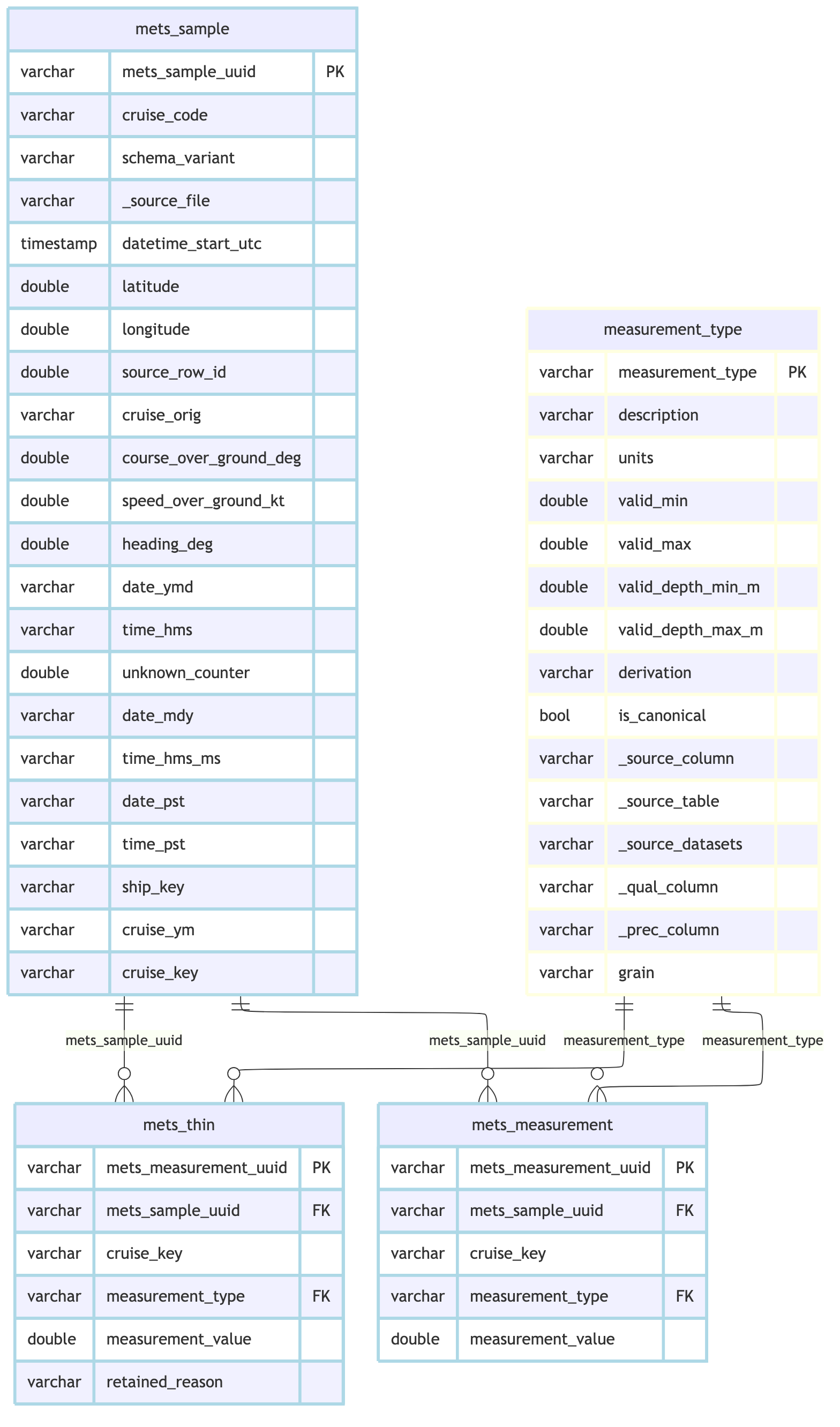
## Schema Diagram
```{r}
#| label: schema
mets_rels <- list(
  primary_keys = list(
    mets_sample      = "mets_sample_uuid",
    mets_thin        = "mets_measurement_uuid",
    mets_measurement = "mets_measurement_uuid",
    measurement_type = "measurement_type"),
  foreign_keys = list(
    list(table = "mets_thin", column = "mets_sample_uuid",
         ref_table = "mets_sample", ref_column = "mets_sample_uuid"),
    list(table = "mets_thin", column = "measurement_type",
         ref_table = "measurement_type", ref_column = "measurement_type"),
    list(table = "mets_measurement", column = "mets_sample_uuid",
         ref_table = "mets_sample", ref_column = "mets_sample_uuid"),
    list(table = "mets_measurement", column = "measurement_type",
         ref_table = "measurement_type", ref_column = "measurement_type")))

# tables= is REQUIRED here, not optional: without it cc_erd() diagrams every
# table in the connection — including the loaded ship/cruise/grid/dataset refs
# and all ~50 columns of mets_sample. That graph is large enough to wedge the
# headless-Chrome mermaid renderer indefinitely (no figure emitted, ~0% CPU),
# which looks like a hang rather than a slow render. Same explicit list every
# other ingest passes.
cc_erd(
  con,
  tables = c("mets_sample", "mets_thin", "mets_measurement", "measurement_type"),
  rels   = mets_rels,
  colors = list(
    lightblue   = c("mets_sample", "mets_thin", "mets_measurement"),
    lightyellow = "measurement_type"))
```
## Add Spatial
`mets_raw_2012` rows have no lat/lon at all (see questions.csv
mets_16) — they'll get a NULL `geom`/`grid_key` here unless position is
joined in from elsewhere before this step. `add_point_geom`/
`assign_grid_key` presumably no-op or leave NULL on missing coordinates
rather than error, but that's unverified against real behavior — worth
checking on first run whether this schema's rows survive downstream
validation with a NULL grid_key, or need excluding until mets_16 resolves.
### `Longitude_W` is unsigned in some eras — negate it before gridding
`mets_20` asks whether the `_W` suffix means "already signed negative" or "west
as an unsigned magnitude". The answer turns out to be **both, across different
schema eras**, and nothing negated the unsigned form: **169,124 samples across 5
cruises** carried longitudes of **+117.18 to +124.91** — the CalCOFI grid
reflected into the eastern hemisphere.
Reflected coordinates match no grid cell, and `append_obs()` used to filter on
`grid_key IS NOT NULL` while the `sample` arm did not. So four of those cruises
(`2013-01-3322`, `2013-04-3322`, `2014-02-3322`, `2014-04-32I1`) reached release
v2026.08.08 as **11,762 underway samples with zero observations**, with 1,728,548
measurements and 1,147,814 `obs_mets_full` rows behind them. The fifth,
`2015-10-32OC`, lost 1,441 samples *inside an otherwise healthy cruise* — invisible
to any cruise-level check, since the rest of its track grids normally.
The sign repair is still the right fix — a positive longitude here is simply
**wrong**, not merely ungridded. But that filter is gone as of v2026.08.11:
`obs` now carries ungridded observations, extending to the headline table the
argument this notebook already made for `obs_mets_full` below (a ship on transit
is legitimately outside the station grid). Being outside the grid no longer
deletes an observation anywhere, so a coordinate error like this one can no
longer hide as an absence.
This is repaired rather than asked, because the alternative is not a place a
CalCOFI ship has been: +117° to +125° E at 29–37° N is inland China and the
Taiwan Strait. The guard is deliberately narrow — only the mirrored CalCOFI
window is touched — so a genuine eastern-hemisphere coordinate would survive to
fail the assertion rather than be silently reflected.
```{r}
#| label: fix_lon_sign
# NOTE: must run BEFORE add_point_geom(). DuckDB fails an UPDATE on a table
# carrying a CRS-tagged GEOMETRY column (through >= v1.5.1), and `geom` does not
# exist yet at this point.
lon_flip <- dbGetQuery(con, "
  SELECT cruise_key, COUNT(*) AS n,
         ROUND(MIN(longitude), 3) AS lon_min, ROUND(MAX(longitude), 3) AS lon_max
  FROM mets_sample
  WHERE longitude > 0 AND NOT isnan(longitude)
    AND longitude BETWEEN 110 AND 130
  GROUP BY 1 ORDER BY 1")

if (nrow(lon_flip) > 0) {
  dbExecute(con, "
    UPDATE mets_sample SET longitude = -longitude
    WHERE longitude > 0 AND NOT isnan(longitude)
      AND longitude BETWEEN 110 AND 130")
  cat(glue(
    "Longitude sign repaired: {format(sum(lon_flip$n), big.mark = ',')} sample(s) ",
    "across {nrow(lon_flip)} cruise(s) negated\n"))
  lon_flip |>
    dt(caption = paste(
      "Unsigned `Longitude_W` values negated before gridding — see mets_20.",
      "Ranges shown are as-published (positive)."),
      fname = "mets_longitude_sign_repair")
} else {
  cat("Longitude sign: nothing to repair\n")
}
# `isnan()` explicitly: NaN > 0 is TRUE in DuckDB, so a NaN coordinate would
# otherwise read as a positive longitude here and again in the assertion.
stopifnot(
  "a positive longitude survived the sign repair — outside the CalCOFI window?" =
    dbGetQuery(con, "
      SELECT COUNT(*) AS n FROM mets_sample
      WHERE longitude > 0 AND NOT isnan(longitude)")[[1]] == 0)
```
```{r}
#| label: add_spatial
add_point_geom(con, "mets_sample", lon_col = "longitude", lat_col = "latitude")
assign_grid_key(con, "mets_sample")
```
## Emit Core Tables
Project METS into the shared consolidated core model. The `underway` sample grain
already exists — `swfsc_cufes` uses it — and `obs` is fed by **`mets_thin`**, the
same pattern `calcofi_ctd-cast` follows (its `obs` carries `ctd_thin`, not the
full scan set). Thinning is what makes this proportionate: the full ~1-minute
series is 20.5M rows and stays a supplemental output, while the thinned track
lands in the database like any other dataset. `sample` carries only the samples
`mets_thin` references, so the event dimension does not fill with rows that have
no `obs`.
Underway seawater is drawn from a hull intake a few metres down; the exact depth
is undocumented per cruise (`questions.csv` `mets_25`), so depth is recorded as
surface — matching `swfsc_cufes`.
```{r}
#| label: emit_core
ds_key <- "calcofi_mets"

# This projection lives here, in the notebook that owns the dataset, not in a
# switch(dataset_key, ...) arm inside calcofi4db. METS is env-only: no taxa
# references, no taxon_key on obs.
#
# sample — one row per RETAINED track sample. Restricted to the samples mets_thin
# references so `sample` stays proportionate to `obs`; the full ~1-minute series
# is a supplemental output, not a core event dimension.
append_sample(con, glue("
  SELECT {ns_key(ds_key, 'underway', 's.mets_sample_uuid')} AS sample_key,
         'underway' AS sample_type,
         NULL::VARCHAR AS parent_sample_key,
         {ns_key(ds_key, 'underway', 's.mets_sample_uuid')} AS root_sample_key,
         '{ds_key}' AS dataset_key, s.grid_key, NULL::VARCHAR AS site_key, s.cruise_key,
         NULL::INTEGER AS order_occ, s.latitude, s.longitude,
         CAST(s.datetime_start_utc AS TIMESTAMP) AS datetime,
         0::DOUBLE AS depth_min_m, 0::DOUBLE AS depth_max_m,
         NULL::VARCHAR AS tow_type
  FROM mets_sample s
  WHERE EXISTS (SELECT 1 FROM mets_thin t
                WHERE t.mets_sample_uuid = s.mets_sample_uuid)"))

# obs — env realm, fed by the THINNED table
append_obs(con, glue("
  SELECT 'env', '{ds_key}', {ns_key(ds_key, 'underway', 't.mets_sample_uuid')},
         s.grid_key, s.cruise_key, s.latitude, s.longitude,
         CAST(s.datetime_start_utc AS TIMESTAMP), 0::DOUBLE, 0::DOUBLE,
         NULL::VARCHAR, NULL::VARCHAR, t.measurement_type, t.measurement_value,
         NULL::VARCHAR, NULL::DOUBLE
  FROM mets_thin t JOIN mets_sample s USING (mets_sample_uuid)"))

core <- list(
  sample = dbGetQuery(con, "SELECT COUNT(*) FROM sample")[[1]],
  obs    = dbGetQuery(con, "SELECT COUNT(*) FROM obs")[[1]])
cat(glue(
  "core projection — sample={core$sample %||% 0} obs={core$obs %||% 0}\n"))
n_obs <- core$obs
n_exp <- dbGetQuery(con,
  "SELECT COUNT(*) FROM mets_thin t JOIN mets_sample s USING (mets_sample_uuid)")[[1]]
n_smp_exp <- dbGetQuery(con,
  "SELECT COUNT(*) FROM mets_sample s
   WHERE EXISTS (SELECT 1 FROM mets_thin t WHERE t.mets_sample_uuid = s.mets_sample_uuid)")[[1]]
stopifnot(
  "obs must be one row per mets_thin measurement" = n_obs == n_exp,
  "sample must carry only the samples mets_thin references"    = core$sample == n_smp_exp,
  "underway is the only sample grain here" =
    dbGetQuery(con, "SELECT COUNT(*) FROM sample WHERE sample_type <> 'underway'")[[1]] == 0,
  "every obs.sample_key must resolve in sample" =
    dbGetQuery(con, "SELECT COUNT(*) FROM obs o
                     LEFT JOIN sample s USING (sample_key)
                     WHERE s.sample_key IS NULL")[[1]] == 0)
cat(glue("obs parity: {format(n_obs, big.mark = ',')} rows"), "\n")
# obs must carry the THINNED series, not the full one — that is the whole point
# of mets_thin, and a regression here would silently 40x the core
stopifnot(
  "obs must be fed by mets_thin, not mets_measurement" =
    n_obs < dbGetQuery(con, "SELECT COUNT(*) FROM mets_measurement")[[1]])
```
### `obs_mets_full` — the full ~1-minute series, with its own coordinates
`mets_measurement` alone is **not usable as a published product**: it carries
`mets_sample_uuid`, `measurement_type`, `measurement_value` and `cruise_key` — and
no time or position. Its events live in `mets_sample`, which is *not* published,
and core `sample` holds only the **thinned** events. So of its **2,366,547**
distinct underway events only **77,795 (3.3%)** could ever be resolved by a
consumer; the other 96.7% were unreachable. It could not be served to ERDDAP at
all, and any "later use / transformation" would have had to reconstruct
coordinates that were never shipped.
This mirrors `calcofi_ctd-cast`'s `obs_ctd_full`: the same core `obs` shape, with
`latitude`/`longitude`/`datetime`/`cruise_key`/`grid_key` **denormalized onto every
row**, so the supplemental table stands on its own exactly as the CTD one does.
::: {.callout-note title="Gated on a POSITION, not on grid_key"}
`obs_ctd_full` gates on `grid_key IS NOT NULL`, and copying that here would have
been wrong for underway data: a ship on transit is legitimately *outside* the
CalCOFI station grid, so the grid filter discarded **1,173,522 measurements that
carry a perfectly good latitude and longitude** (18,762,551 kept of 19,936,073
positioned). A record whose purpose is "the full series, for later use and
transformation" must not drop 6% of its positioned rows for failing to sit on a
station. The gate here is therefore a resolvable position, which is also exactly
what makes the table servable to ERDDAP. Rows with no position at all (637,177,
3.1%) are still excluded — they cannot be placed in space or served.
:::
```{r}
#| label: emit_obs_full
# heavy (~20.6M rows); set BUILD_OBS_METS_FULL=FALSE for a fast structural render.
build_obs_mets_full <- as.logical(Sys.getenv("BUILD_OBS_METS_FULL", "TRUE"))
if (build_obs_mets_full) {
  n_full <- append_obs(con, obs_tbl = "obs_mets_full", select_sql = glue("
    SELECT 'env' realm, '{ds_key}' dataset_key,
           {ns_key(ds_key, 'underway', 's.mets_sample_uuid')} sample_key,
           s.grid_key, s.cruise_key, s.latitude, s.longitude,
           CAST(s.datetime_start_utc AS TIMESTAMP) datetime,
           0::DOUBLE depth_min_m, 0::DOUBLE depth_max_m,
           NULL::VARCHAR taxon_key, NULL::VARCHAR life_stage,
           m.measurement_type, m.measurement_value,
           NULL::VARCHAR measurement_qual, NULL::DOUBLE measurement_prec
    FROM mets_measurement m
    JOIN mets_sample s USING (mets_sample_uuid)
    WHERE s.latitude IS NOT NULL AND s.longitude IS NOT NULL
      -- NaN passes IS NOT NULL, and append_obs() normalises it to NULL
      -- (calcofi4db 3.13.1) — so a NaN row would enter here as 'positioned'
      -- and land with a NULL position, failing the assertion below. A NaN is
      -- not a resolvable position, which is exactly what this gate means.
      AND NOT isnan(s.latitude)  AND NOT isinf(s.latitude)
      AND NOT isnan(s.longitude) AND NOT isinf(s.longitude)"))

  n_exp_full <- dbGetQuery(con, "
    SELECT COUNT(*) FROM mets_measurement m
    JOIN mets_sample s USING (mets_sample_uuid)
    WHERE s.latitude IS NOT NULL AND s.longitude IS NOT NULL
      -- NaN passes IS NOT NULL, and append_obs() normalises it to NULL
      -- (calcofi4db 3.13.1) — so a NaN row would enter here as 'positioned'
      -- and land with a NULL position, failing the assertion below. A NaN is
      -- not a resolvable position, which is exactly what this gate means.
      AND NOT isnan(s.latitude)  AND NOT isinf(s.latitude)
      AND NOT isnan(s.longitude) AND NOT isinf(s.longitude)")[[1]]
  stopifnot(
    "obs_mets_full must cover every measurement" = n_full == n_exp_full,
    # the whole point: unlike mets_measurement, this stands alone
    "obs_mets_full must carry a position on every row" =
      dbGetQuery(con, "SELECT COUNT(*) FROM obs_mets_full
                       WHERE latitude IS NULL OR longitude IS NULL")[[1]] == 0,
    "obs_mets_full must be strictly larger than the thinned obs" = n_full > n_obs)

  # the supplemental table gets the same bounds assertion as `obs` — it is
  # published, and until v2026.08.08 nothing checked it. It derives from the
  # guarded mets_measurement, so a violation here means that link is broken.
  b_full <- check_measurement_bounds(con, "obs_mets_full", mt = d_meas_type)
  bounds_datatable(b_full)
  cat(glue("obs_mets_full bounds: {sum(b_full$status == 'ok')} ok, ",
           "{sum(b_full$status == 'undeclared')} undeclared — the full series ",
           "carries far more sensor channels than the thinned `obs`, and most ",
           "still show the -99 marker (Q26/Q27)"), "\n")
  stopifnot(
    "obs_mets_full must inherit the bounds guard applied to mets_measurement" =
      sum(b_full$status == "out_of_range") == 0)

  n_evt <- dbGetQuery(con,
    "SELECT COUNT(DISTINCT sample_key) FROM obs_mets_full")[[1]]
  cat(glue("obs_mets_full: {format(n_full, big.mark=',')} rows over ",
           "{format(n_evt, big.mark=',')} underway events ",
           "({round(100 * n_evt / dbGetQuery(con, 'SELECT COUNT(*) FROM mets_sample')[[1]], 1)}% ",
           "of all mets_sample events)"), "\n")
} else {
  cat("obs_mets_full skipped (BUILD_OBS_METS_FULL=FALSE)\n")
}
```
## Load Dataset Metadata
```{r}
#| label: load-dataset-metadata
d_dataset <- ingest_yaml_to_dataset_df(read_ingest_yaml(here()))
dbWriteTable(con, "dataset", d_dataset, overwrite = TRUE)
cat(glue("dataset: {nrow(d_dataset)} datasets registered"), "\n")
```
## Questions for Data Providers
```{r}
#| label: provider-questions
# one validated read + render for every ingest: the vocabulary and the column
# order live in calcofi4db, not in 16 hand-written factor() calls
questions_datatable(
  here(cc$questions_file),
  caption = "Questions for the CalCOFI METS data providers (ranked)")
```
## Validate and Enforce Types
```{r}
#| label: validate
validate_for_release(con)
enforce_column_types(con, d_flds_rd = d_flds_rd)
```
## Preview Tables
```{r}
#| label: preview
#| results: asis
preview_tables(con, tables = c("mets_sample", "mets_thin", "measurement_type"))
```
## Write Parquet
```{r}
#| label: write_parquet
mismatches <- list(
  ships             = collect_ship_mismatches(con, "mets_sample"),
  measurement_types = collect_measurement_type_mismatches(
    con, here("metadata/measurement_type.csv")),
  cruise_keys       = collect_cruise_key_mismatches(con, "mets_sample"))

# obs_mets_full replaces mets_measurement as the published full-resolution
# product: same rows, but in core `obs` shape with time and position on every row,
# so a consumer can use it without the unpublished mets_sample event table.
# mets_measurement stays an internal wrangling table and is no longer exported.
tbls_out <- core_output_tables(
  con, extra = c("obs_mets_full", "measurement_type", "dataset"))
parquet_stats <- write_parquet_outputs(
  con          = con,
  output_dir   = dir_parquet,
  tables       = tbls_out,
  partition_by = list(obs_mets_full = "cruise_key"),
  # Sort key MUST match `core_sort` in release_database.qmd, so the shard the
  # release reads is already clustered the way it re-exports it. Two parts
  # matter and both were measured, not guessed:
  #   grid_key FIRST co-locates every column that is a function of the cast —
  #     sample_key, hex_id, latitude, longitude, datetime — which is most of the
  #     row width. measurement_type-first clusters one 54-value column and
  #     scatters the rest: 4.61 GB vs 1.22 GB for obs_ctd_full.
  #   datetime LAST is not decoration. (grid_key, depth_min_m, measurement_type)
  #     leaves large tie groups, and rows inside a tie land in arbitrary order,
  #     scattering lat/lon/datetime again. Adding the tiebreak made a partition
  #     27.55 -> 20.20 MB (CTD) and 23.22 -> 16.95 MB (mets), i.e. ~27% below
  #     what the release's own re-export produced. Do not drop it.
  sort_by      = list(
    obs           = c("grid_key", "measurement_type"),
    obs_mets_full = c("grid_key", "depth_min_m", "measurement_type", "datetime")),
  strip_provenance = FALSE,
  mismatches       = mismatches,
  # the core (sample/obs) is the database; the full ~1-minute series ships
  # alongside for anyone who needs between-the-hours resolution
  supplemental     = c("obs_mets_full"))

parquet_stats |> dt(fname = "mets_parquet_stats")
```
## Write Metadata JSON
```{r}
#| label: write_metadata
metadata_path <- build_metadata_json(
  con                  = con,
  d_tbls_rd            = d_tbls_rd,
  d_flds_rd            = d_flds_rd,
  metadata_derived_csv = glue("{dir_meta}/metadata_derived.csv"),
  output_dir           = dir_parquet,
  tables               = parquet_stats$table,
  provider             = provider,
  dataset              = dataset,
  workflow_url         = cc$workflow_url,
  tables_owned         = tables_owned)
build_relationships_json(
  rels = core_relationships(tbls_out), output_dir = dir_parquet,
  provider = provider, dataset = dataset)
```
## Export Modified Dependency Deltas
```{r}
#| label: export_new_deltas
for (tbl in modifies_tables) {
  pk_col   <- modifies_pks[[tbl]]$pk_col
  keys_old <- modifies_pks[[tbl]]$keys
  keys_new <- dbGetQuery(con, glue("SELECT {pk_col} FROM {tbl}"))[[1]]
  additions <- setdiff(keys_new, keys_old)
  if (length(additions) > 0) {
    pq_path <- file.path(dir_stage, paste0(tbl, "_new.parquet"))
    vals <- paste(dbQuoteString(con, additions), collapse = ", ")
    export_parquet(con, glue("SELECT * FROM {tbl} WHERE {pk_col} IN ({vals})"), pq_path)
    cat(glue("{length(additions)} new {tbl} row(s) -> {tbl}_new.parquet"), "\n")
  }
}
```
## Upload to GCS
```{r}
#| label: upload_gcs
#| eval: true
knitr::opts_chunk$set(eval = TRUE)
if (parquet_complete) {
  cat("Parquet unchanged — skipping GCS sync", "\n")
} else {
  sync_to_gcs(local_dir = dir_stage, sidecar_dir = dir_parquet, gcs_prefix = glue("ingest/{dir_label}"),
              bucket = "calcofi-db", delete_stale = TRUE)
}
```
## Cleanup
```{r}
#| label: cleanup
close_duckdb(con)
if (file_exists(db_checkpoint)) {
  file_delete(db_checkpoint)
  cat(glue("Removed checkpoint: {db_checkpoint}"), "\n")
}
```
::: {.callout-caution collapse="true"}
## Session Info
```{r session_info}
devtools::session_info()
```
:::