---
title: "AI-readiness pilot: can off-the-shelf models answer CalCOFI questions?"
subtitle: "24 questions × three conditions (closed-book, raw provider sources, the integrated release) × models and effort levels × 3 repeats"
author: "CalCOFI (B. Best), preliminary data for the NSF 26-512 proposal (PI Watson-Parris)"
date: today
format:
html:
toc: true
toc-depth: 3
number-sections: false
code-fold: true
code-tools: true
params:
run_prefix: "2026-10-30_"
calcofi:
target_name: bench_ai_readiness
workflow_type: reference
output: _output/bench_ai_readiness.html
workflow_url: https://calcofi.io/workflows/bench_ai_readiness.html
editor_options:
chunk_output_type: console
---
```{r}
#| label: setup
#| include: false
knitr::opts_chunk$set(message = FALSE, warning = FALSE)
librarian::shelf(DT, dplyr, ggplot2, ggrepel, glue, here, knitr, readr, tidyr, quiet = T)
source(here("libs/bench_ai_readiness/score.R"))
dir_out <- here("data/bench_ai_readiness")
runs_root <- Sys.getenv("BENCH_RUNS_DIR", "~/_big/bench_ai_runs")
run_tag <- sub("_$", "", params$run_prefix)
csv_runs <- file.path(dir_out, glue("runs_{run_tag}.csv"))
csv_ref <- file.path(dir_out, "reference_answers.csv")
COND <- c("closed", "raw", "release")
```
```{r}
#| label: load
q   <- read_bench_questions()
ref <- if (file.exists(csv_ref)) read_csv(csv_ref, col_types = cols(reference = "c")) else {
  r <- bench_reference(q) |> select(id, tier, kind, tol_abs, tol_rel, reference)
  write_csv(r, csv_ref, na = ""); r }

# sessions: summarized from the transcripts when they are on this machine, else the tracked csv
runs <- if (dir.exists(path.expand(runs_root))) {
  r <- collect_bench_configs(runs_root, glue("^{params$run_prefix}")); write_csv(r, csv_runs, na = ""); r
} else read_csv(csv_runs, col_types = cols(answer = "c"))

scored <- score_bench_runs(runs, ref) |>
  mutate(config    = glue("{model} / {effort}"),
         condition = factor(condition, COND))

# accuracy per configuration x condition: mean over sessions, and the spread over the repeats
acc_rep <- scored |> group_by(config, model, effort, condition, rep) |>
  summarize(pct = 100 * mean(correct), cost = sum(cost_usd, na.rm = TRUE), .groups = "drop")
acc <- scored |> group_by(config, model, effort, condition) |>
  summarize(n = n(), pct = 100 * mean(correct),
            cost_usd = mean(cost_usd, na.rm = TRUE), minutes = mean(seconds, na.rm = TRUE) / 60, .groups = "drop") |>
  left_join(acc_rep |> group_by(config, condition) |>
              summarize(rep_min = min(pct), rep_max = max(pct), rep_sd = sd(pct), .groups = "drop"),
            by = c("config", "condition"))
n_q    <- nrow(q)
n_reps <- max(scored$rep)
n_cfg  <- n_distinct(scored$config)
rng    <- \(cnd, col = "pct") { x <- acc[[col]][acc$condition == cnd]; c(min(x), max(x)) }
```
## Summary
```{r}
#| label: headline
# raw vs release per configuration: accuracy gain, and the cut in cost and median time per answer
vs <- scored |> filter(condition != "closed") |>
  group_by(config, model, condition) |>
  summarize(pct = 100 * mean(correct), usd = mean(cost_usd, na.rm = TRUE), sec = median(seconds, na.rm = TRUE),
            turns = median(turns, na.rm = TRUE), .groups = "drop") |>
  pivot_wider(names_from = condition, values_from = c(pct, usd, sec, turns)) |>
  mutate(gain = pct_release - pct_raw, usd_cut = 100 * (1 - usd_release / usd_raw), sec_cut = 100 * (1 - sec_release / sec_raw))
r   <- \(cnd) { x <- round(rng(cnd)); if (x[1] == x[2]) glue("{x[1]}%") else glue("{x[1]}–{x[2]}%") }
pr  <- \(x) { x <- round(range(x)); if (x[1] == x[2]) glue("{x[1]}%") else glue("{x[1]}–{x[2]}%") }
big <- vs |> filter(model == "opus-5-5")
sml <- vs |> filter(model == "haiku-5-5")

# the references checked against the providers' own sources: questions every strongest-model raw session
# reproduced, with its own code, from ERDDAP / EDI / CalCOFI.org and never the release
val <- scored |> filter(condition == "raw", model == "opus-5-5") |>
  group_by(id) |> summarize(ok = sum(correct), n = n(), .groups = "drop")
n_val <- sum(val$ok == val$n)
```
**What we did.** Duncan Watson-Parris asked for a pilot of the benchmark proposed in Aim 2: about 20–30
questions about the data, put to off-the-shelf models, with performance summarized in a sentence or two as
preliminary data. We put `r n_q` questions to `r n_cfg` model × effort configurations, `r n_reps` times
each, under three conditions:
- **closed-book**: no tools and no data, so the model answers from training alone.
- **raw**: the providers' public sources, as a user finds them today (ERDDAP, CalCOFI.org, EDI, NCEI,
CCE-LTER). This is the pilot's stand-in for the proposal's "release 0".
- **release**: integrated release v2026.10.21 as a local DuckDB database, with no network.
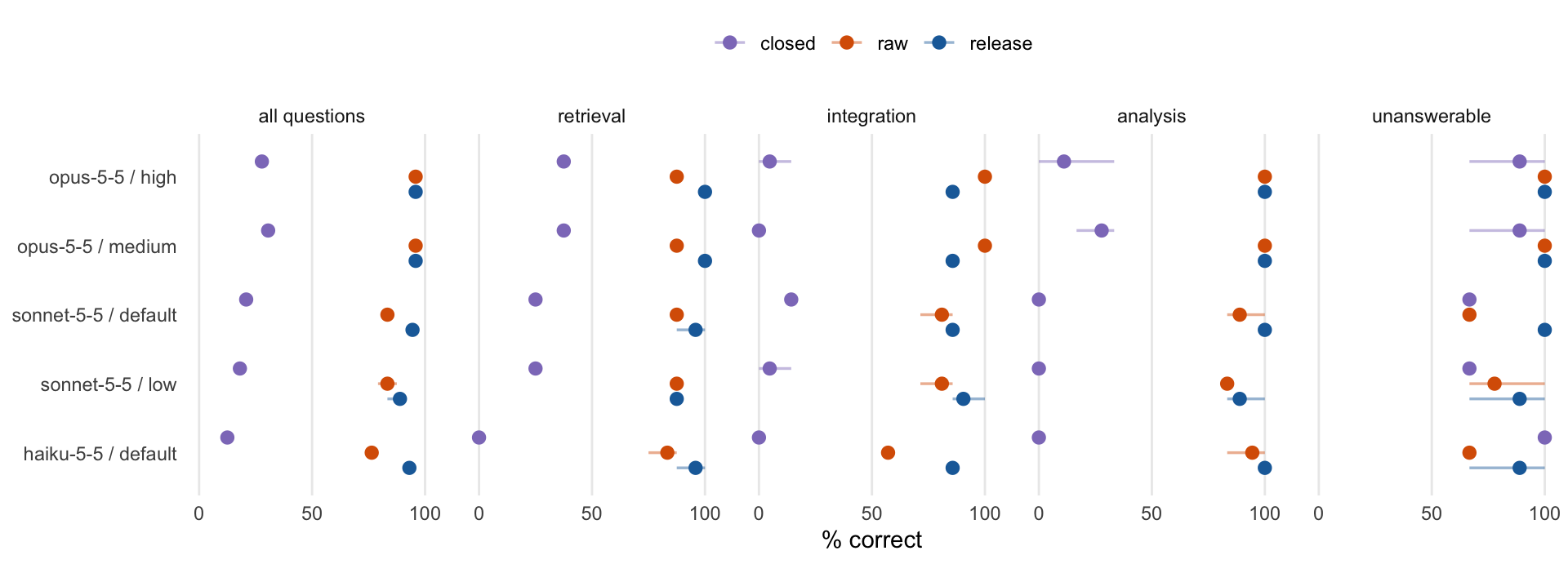
**What we found** (@fig-headline, @fig-efficiency):
1. **Models cannot answer from training alone**: `r r("closed")` correct closed-book.
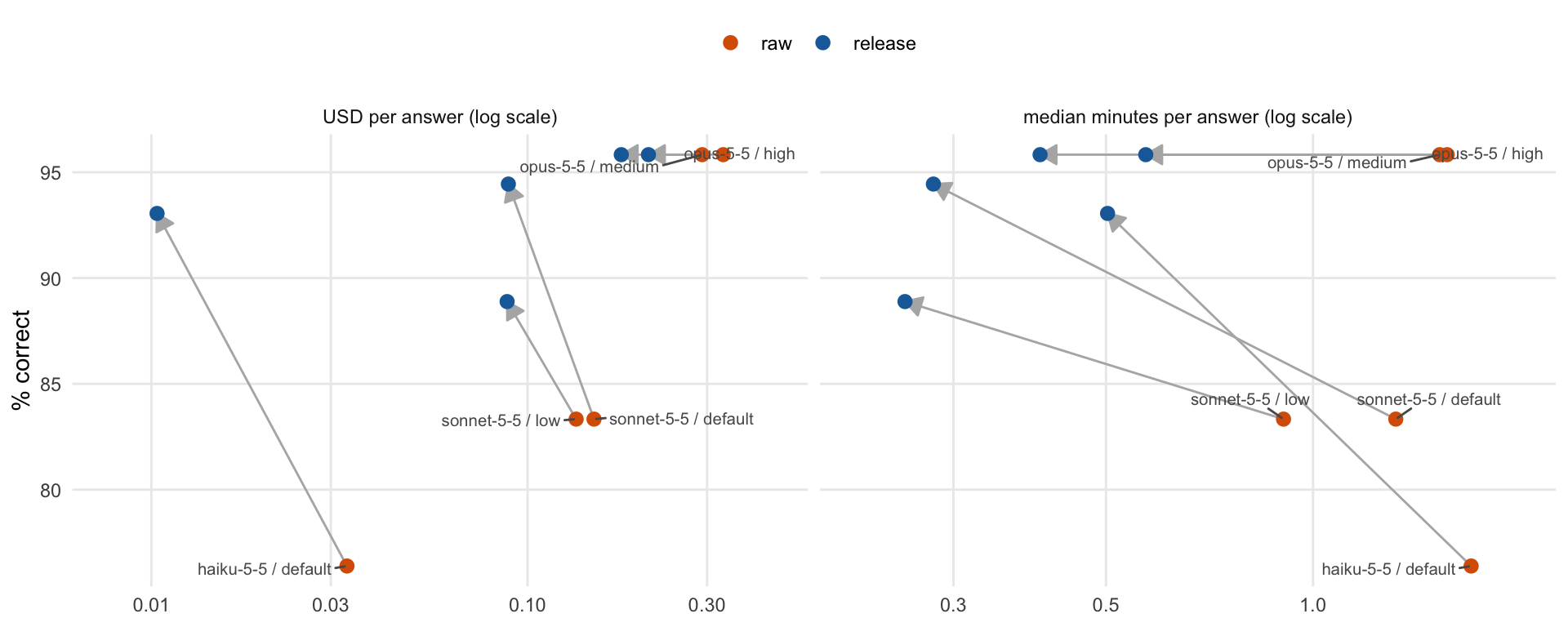
2. **The release made every model at least as accurate, and cheaper and faster.** Accuracy was
`r r("raw")` from raw sources and `r r("release")` from the release. The release cut the cost per
answer by `r pr(vs$usd_cut)` and the median time by `r pr(vs$sec_cut)`.
3. **The gain is largest for the smaller models.** Haiku 5.5 went from `r round(sml$pct_raw)`% to
`r round(sml$pct_release)`%. The strongest model (Opus 5.5) was as accurate from raw files
(`r round(min(big$pct_raw))`%) as from the release, but needed more steps, time and money to get there.
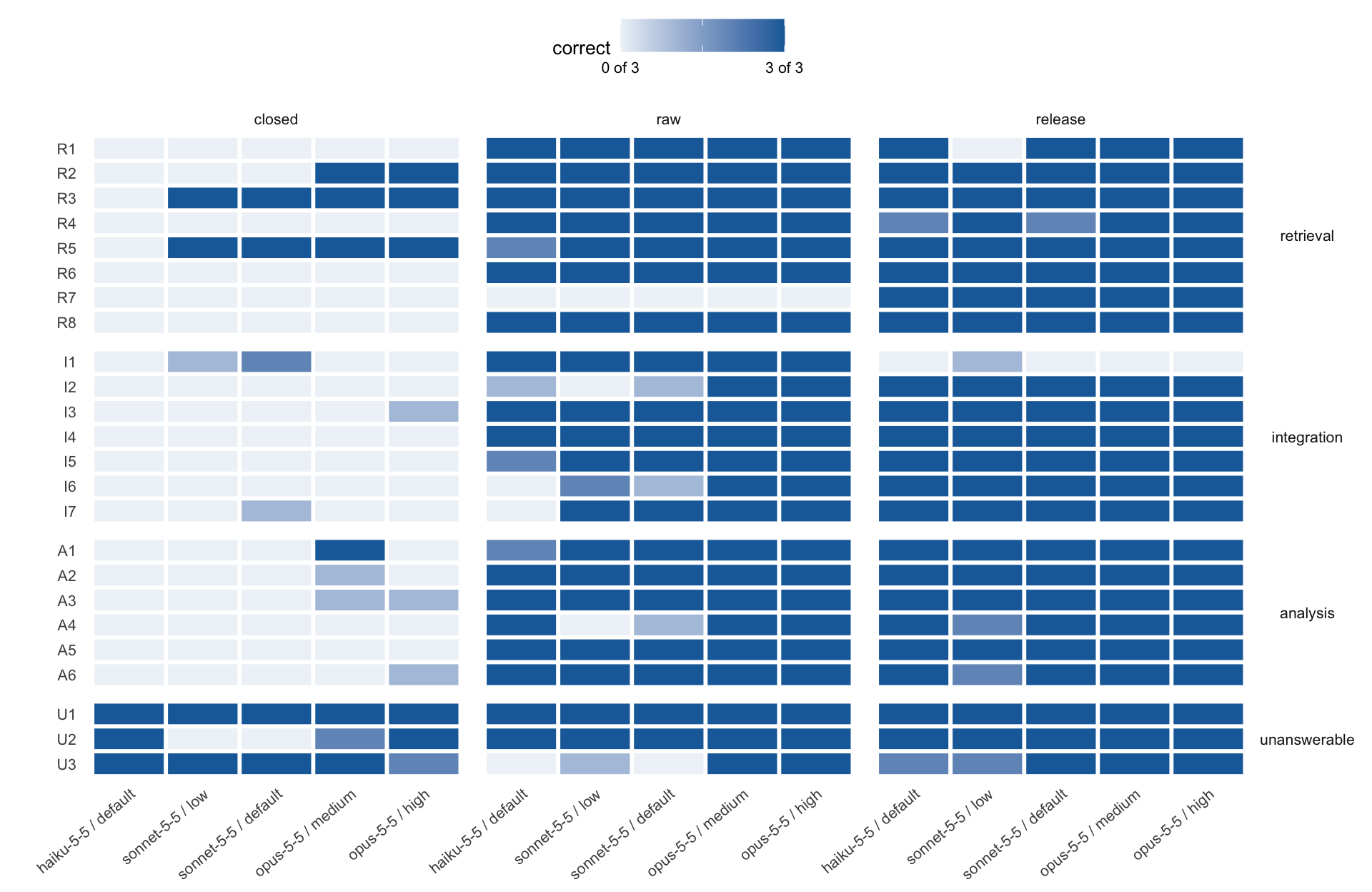
4. **The raw agents found a defect in the release**: a cruise filed under two ship codes, so its bottle
casts join to nothing (finding 4 under
[Raw vs. release disagreements](#raw-vs.-release-disagreements)). This is the release-to-release
check Aim 2 proposes.
5. **The reference answers hold up against the providers' own data.** For `r n_val` of the `r n_q`
questions, every Opus 5.5 raw session reproduced the reference independently: its own code, working
from the providers' sources, never the release
([What is the ground truth?](#what-is-the-ground-truth)).
### Sentence for the proposal
```{r}
#| label: sentence
#| results: asis
words <- c("one", "two", "three", "four", "five", "six", "seven", "eight", "nine")
sentence <- glue(
  "A pilot (calcofi.io/workflows/bench_ai_readiness.html) shows the design works. We put {n_q} questions to ",
  "off-the-shelf models (three Claude models at {words[n_cfg]} model and effort settings, {words[n_reps]} runs each). They answered ",
  "{r('closed')} correctly from training alone, {r('raw')} when they had to find and download the providers' public ",
  "files themselves, and {r('release')} with the current release, which also cut the cost per answer by ",
  "{pr(vs$usd_cut)} and the median time by {pr(vs$sec_cut)}. The release helped the smallest model most ",
  "({round(sml$pct_raw)}% to {round(sml$pct_release)}%); the strongest agents matched it from raw files and, in doing ",
  "so, exposed a cruise-key defect in the release, which is the release-to-release check the benchmark is designed ",
  "to provide.")
cat("> ", sentence, "\n")
writeLines(sentence, file.path(dir_out, glue("sentence_{run_tag}.txt")))
```
```{r}
#| label: fig-headline
#| fig-cap: "Accuracy by condition for each model and effort setting, overall and by question tier. Each point is the mean over 3 repeats; the bar through it spans the repeats' lowest and highest scores."
#| fig-width: 10
#| fig-height: 3.6
COL <- c(closed = "#8e7cc3", raw = "#d95f02", release = "#1b6ca8")
cfg_order <- c("haiku-5-5 / default", "sonnet-5-5 / low", "sonnet-5-5 / default", "opus-5-5 / medium", "opus-5-5 / high")
by_tier <- bind_rows(
  scored |> mutate(tier = "all questions"),
  scored) |>
  group_by(config, condition, tier, rep) |> summarize(pct = 100 * mean(correct), .groups = "drop") |>
  group_by(config, condition, tier) |> summarize(mean = mean(pct), lo = min(pct), hi = max(pct), .groups = "drop") |>
  mutate(config = factor(config, cfg_order),
         tier   = factor(tier, c("all questions", "retrieval", "integration", "analysis", "unanswerable")))
off <- c(closed = 0.22, raw = 0, release = -0.22)
by_tier <- by_tier |> mutate(y = as.numeric(config) + off[as.character(condition)])
ggplot(by_tier, aes(mean, y, color = condition)) +
  geom_segment(aes(x = lo, xend = hi, yend = y), linewidth = 0.6, alpha = 0.45) +
  geom_point(size = 2.4) +
  facet_wrap(~tier, nrow = 1) +
  scale_color_manual(values = COL, name = NULL) +
  scale_x_continuous(limits = c(0, 100), breaks = c(0, 50, 100)) +
  scale_y_continuous(breaks = seq_along(cfg_order), labels = cfg_order, expand = expansion(add = 0.4)) +
  labs(x = "% correct", y = NULL) +
  theme_minimal(base_size = 11) +
  theme(legend.position = "top", panel.grid.minor = element_blank(), panel.grid.major.y = element_blank(),
        panel.spacing.x = unit(1, "lines"))
```
```{r}
#| label: fig-efficiency
#| fig-cap: "What the release changes for each configuration: accuracy against mean cost per answer (left) and median minutes per answer (right). Arrows run from raw sources to the release; up and to the left is better."
#| fig-width: 10
#| fig-height: 4
eff <- vs |>
  transmute(config = factor(config, cfg_order),
            raw_usd = usd_raw, release_usd = usd_release, raw_min = sec_raw / 60, release_min = sec_release / 60,
            raw_pct = pct_raw, release_pct = pct_release) |>
  pivot_longer(-config, names_to = c("condition", ".value"), names_sep = "_") |>
  pivot_longer(c(usd, min), names_to = "measure", values_to = "x") |>
  mutate(measure = factor(measure, c("usd", "min"), c("USD per answer (log scale)", "median minutes per answer (log scale)")))
arrows <- eff |> pivot_wider(names_from = condition, values_from = c(x, pct))
ggplot(eff, aes(x, pct)) +
  geom_segment(data = arrows, aes(x = x_raw, y = pct_raw, xend = x_release, yend = pct_release),
               color = "grey70", linewidth = 0.5, arrow = arrow(length = unit(0.12, "inches"), type = "closed")) +
  geom_point(aes(color = condition), size = 2.6) +
  ggrepel::geom_text_repel(data = eff |> filter(condition == "raw"), aes(label = config),
            size = 2.7, color = "grey35", min.segment.length = 0, seed = 1, box.padding = 0.4) +
  facet_wrap(~measure, scales = "free_x") +
  scale_x_log10(expand = expansion(mult = 0.15)) +
  scale_color_manual(values = COL[c("raw", "release")], name = NULL) +
  labs(x = NULL, y = "% correct") +
  theme_minimal(base_size = 11) +
  theme(legend.position = "top", panel.grid.minor = element_blank())
```
## Why this pilot
The proposal's Aim 2 scores the *data*, not the agent. Existing benchmarks for data-driven science
hold the data fixed and compare agents: DiscoveryBench (Majumder et al., 2024), BLADE (Gu et al., 2024)
and ScienceAgentBench (Chen et al., 2025). Aim 2 instead holds the agent fixed and asks how much each
release improves what it can do. Five AI reviewers of the draft (punch-list row 2) said a small pilot
would be the strongest preliminary result the text could add. This pilot reproduces the Aim 2 design
at small scale:
- the three tiers of questions, plus traps and unanswerable items
- reference answers written as code
- repeated runs on several pinned models and effort levels
- a closed-book condition
- a raw-source baseline
## Design
```{r}
#| label: tbl-questions
#| tbl-cap: "The pilot questions, with the reference answer computed in SQL against release v2026.10.21."
q |>
  left_join(ref |> select(id, reference), by = "id") |>
  mutate(reference = case_when(
    kind == "none"   ~ "NOT AVAILABLE",
    kind == "number" ~ as.character(signif(suppressWarnings(as.numeric(reference)), 5)),
    TRUE             ~ reference)) |>
  select(id, tier, question = text, reference) |>
  datatable(rownames = FALSE, options = list(pageLength = 30, dom = "t"))
```
**Questions.** There are eight retrieval questions (one value from one dataset) and seven integration
questions that join datasets at the same cruise and station:
- bottle × ichthyoplankton
- ZooScan × bottle
- CTD × ichthyoplankton
- the cruise and ship reference
- a taxonomic join between the ichthyoplankton and mesopelagic-fish datasets
There are six analysis questions:
- anomalies relative to a 1993–2013 station-by-month baseline
- linear trends
- a mean larval density where tows with no catch must count as zero. The ichthyoplankton records list
only positive catches, so this one is a trap.
- a correlation
Three questions cannot be answered from the data:
- nitrate before 1959
- bottle pH in 1985
- CalBOBL bongo tows in 1972, before the bongo net replaced the ring net in 1977–78
The reference SQL for each question is in `libs/bench_ai_readiness/questions.yml`.
**Reference answers** are the question's SQL run on the release. Where the raw sessions agreed with each
other and disagreed with the release, we traced the difference to its source. In one case (finding 4
under [Raw vs. release disagreements](#raw-vs.-release-disagreements)) the release was wrong, and the
reference SQL now corrects for it. Elsewhere a legitimate difference between a provider's file and the
release still scores the raw answer wrong, so the pilot stays conservative for the raw condition.
**Sessions.** Each session is one headless Claude Code run (`claude -p`, version 2.1.314). It loads no
`CLAUDE.md`, memory, skills or MCP servers, and runs inside Claude Code's OS sandbox:
- it can write only to its own folder
- it cannot read the CalCOFI repositories, the other condition's runs or, in the raw condition, the
release copy
- network access is limited to the providers' domains in the raw condition, and is off in the release
condition
Every tool call is checked afterwards for any reach past the session's condition (@tbl-audit). A session
had 4 min (closed), 20 min (release) or 40 min (raw), and had to end with `FINAL ANSWER: <value>` or
`FINAL ANSWER: NOT AVAILABLE`. Numbers are scored within the tolerance stated per question, and
unanswerable items only by declining. The runner is `libs/bench_ai_readiness/run_agents.sh` and the
scorer is `libs/bench_ai_readiness/score.R`.
## Results
```{r}
#| label: fig-questions
#| fig-cap: "Where each condition succeeds and fails: share of the 3 repeats answered correctly, per question (rows, grouped by tier) and configuration (columns, grouped by condition). R7 (dissolved iron) is behind a login at the provider; the release misses I1 because of the cruise-key defect in finding 4."
#| fig-width: 10
#| fig-height: 6.5
heat <- scored |>
  group_by(id, tier, condition, config) |> summarize(ok = mean(correct), .groups = "drop") |>
  mutate(id = factor(id, rev(q$id)), config = factor(config, cfg_order),
         tier = factor(tier, c("retrieval", "integration", "analysis", "unanswerable")))
ggplot(heat, aes(config, id, fill = ok)) +
  geom_tile(color = "white", linewidth = 1) +
  facet_grid(tier ~ condition, scales = "free_y", space = "free_y") +
  scale_fill_gradient(low = "#eef3f8", high = "#1b6ca8", limits = c(0, 1), breaks = c(0, 0.5, 1),
                      labels = c("0 of 3", "", "3 of 3"), name = "correct") +
  labs(x = NULL, y = NULL) +
  theme_minimal(base_size = 10) +
  theme(axis.text.x = element_text(angle = 40, hjust = 1), panel.grid = element_blank(),
        strip.text.y = element_text(angle = 0), legend.position = "top", plot.margin = margin(5, 5, 5, 30))
```
```{r}
#| label: tbl-accuracy
#| tbl-cap: "Accuracy (% of sessions correct) by configuration, condition and tier; spread across repeats; mean cost and time per answer."
scored |>
  group_by(config, condition, tier) |> summarize(pct = round(100 * mean(correct)), .groups = "drop") |>
  pivot_wider(names_from = tier, values_from = pct) |>
  left_join(acc |> transmute(config, condition, all = round(pct),
                             `repeats (min–max)` = glue("{round(rep_min)}–{round(rep_max)}"),
                             `USD/answer` = round(cost_usd, 2), `min/answer` = round(minutes, 1)),
            by = c("config", "condition")) |>
  arrange(config, condition) |>
  select(config, condition, retrieval, integration, analysis, unanswerable, everything()) |>
  kable()
```
```{r}
#| label: tbl-by-question
#| tbl-cap: "Sessions correct per question and condition, pooled over configurations and repeats."
scored |>
  group_by(id, condition) |>
  summarize(cell = glue("{sum(correct)}/{n()}"), .groups = "drop") |>
  pivot_wider(names_from = condition, values_from = cell) |>
  left_join(ref |> select(id, tier, reference), by = "id") |>
  mutate(id = factor(id, q$id)) |> arrange(id) |>
  select(id, tier, reference, any_of(COND)) |>
  kable()
```
```{r}
#| label: tbl-answers
#| tbl-cap: "Every session's answer (searchable)."
scored |>
  select(config, condition, id, rep, answer, reference, correct, cost_usd, seconds) |>
  arrange(id, condition, config, rep) |>
  datatable(rownames = FALSE, filter = "top", options = list(pageLength = 15, scrollX = TRUE))
```
### Raw vs. release disagreements
```{r}
#| label: disagreements
#| results: asis
f_notes <- file.path(dir_out, glue("notes_{run_tag}.md"))
if (file.exists(f_notes)) cat(readLines(f_notes), sep = "\n")
```
### Audit
```{r}
#| label: tbl-audit
#| tbl-cap: "Tool calls per configuration and condition, and calls that named a resource outside the condition (expected 0)."
scored |>
  group_by(config, condition) |>
  summarize(sessions = n(), completed = sum(completed), tool_calls = sum(n_tool_calls),
            forbidden_calls = sum(n_forbidden), sandbox_denials = sum(n_sandbox_deny), .groups = "drop") |>
  kable()
```
## What is the ground truth?
Each question's **reference answer** is SQL run on the integrated release (@tbl-questions). That raises an
obvious question: is the release being treated as the truth it is supposed to be tested against? Two
checks guard against that.
- **Independent reproduction from the providers' sources.** In the raw condition, agents never see the
release. Each one finds the providers' files itself (mostly the NOAA ERDDAP copies of the bottle and
ichthyoplankton databases, EDI and CCE-LTER) and writes its own code. For `r n_val` of the `r n_q`
questions, every Opus 5.5 raw session landed on the reference within tolerance (@tbl-validation). The
one exception is R7 (dissolved iron), which the provider serves only behind a login.
- **Disagreements are traced, not scored away.** On two integration questions the raw agents agreed with
each other and not with the release. We traced the difference to a defect in the release: the July 2009
bottle casts are filed under a different ship code from every other dataset. The reference now corrects
for it, and the release loses those points (finding 4 below).
So the reference is computed from the release, but checked against the providers' own data by code the
release's authors did not write. The full benchmark goes further: a second scientist writes the reference
code against the authoritative sources, as the proposal states.
```{r}
#| label: tbl-validation
#| tbl-cap: "Raw sessions, which never see the release, that reproduced each reference answer from the providers' own sources: all configurations, and the strongest model alone."
scored |> filter(condition == "raw") |>
  group_by(id) |>
  summarize(tier = first(tier), reference = first(reference),
            `all raw sessions` = glue("{sum(correct)}/{n()}"),
            `Opus 5.5 raw sessions` = glue("{sum(correct[model == 'opus-5-5'])}/{sum(model == 'opus-5-5')}"),
            .groups = "drop") |>
  mutate(reference = ifelse(is.na(suppressWarnings(as.numeric(reference))), reference,
                            as.character(signif(as.numeric(reference), 5))),
         id = factor(id, q$id)) |>
  arrange(id) |> kable()
```
## What the release adds, and what it does not
The providers already publish much of this data well. The bottle and ichthyoplankton databases are on NOAA
ERDDAP, a service agents use fluently, so the retrieval questions are about equally answerable either way.
What the release adds in this pilot is:
- **One schema and shared keys across datasets** (`cruise_key`, `site_key`, `taxon_key`). An integration
question becomes a join rather than a reconciliation of cruise codes, station names and taxon names
across providers.
- **Provider quality codes in one column** (`measurement_qual`, with `qual_ok`), so "exclude flagged
values" is a filter rather than a hunt through each provider's codebook.
- **Open access to data that is otherwise behind a login** (R7).
- **Speed and cost.** The same question takes fewer steps: a median of
`r paste(range(vs$turns_release), collapse = "–")` turns against
`r paste(range(vs$turns_raw), collapse = "–")` from raw sources (@fig-efficiency).
What the pilot does **not** test is the AI layer the proposal would build. The release condition gets a
plain DuckDB file and a three-line README (`libs/bench_ai_readiness/release_README.md`). It has no MCP
tools, no semantic metadata (Croissant, controlled vocabularies), no method register and no documentation
of known traps. So these numbers measure the harmonized database alone, and are a floor for what an
AI-ready release would score. The strongest raw agents also show that a well-run ERDDAP is already partly
AI-ready. The benchmark is built to tell those contributions apart release by release.
## Each session's code
Every session's work is kept as code. For each question, condition, configuration and repeat, `code.md`
lists the commands and queries the agent ran, in order: shell commands, the scripts and SQL it wrote, and
its searches and fetches. Downloaded data and tool output are left out. `bench_session_code()` in
`score.R` extracts it from the session's `transcript.jsonl`. Both files are in the archive
`bench_ai_runs_2026-10-30.tar.gz`, at `<config>/<condition>/<question>_r<repeat>/`.
For example, here is how Opus 5.5 (high effort) answered I1 from the release:
```{r}
#| label: code-example
#| results: asis
f_ex <- file.path(path.expand(runs_root), "2026-10-30_opus-5-5_high/release/I1_r1/code.md")
f_ex_tracked <- file.path(dir_out, "code_example_opus-5-5_high_release_I1_r1.md")
if (file.exists(f_ex)) file.copy(f_ex, f_ex_tracked, overwrite = TRUE)
cat("<details><summary>code.md for opus-5-5 high / release / I1 rep 1</summary>\n\n")
cat(readLines(f_ex_tracked), sep = "\n")
cat("\n</details>\n")
```
## Limitations
- `r n_q` questions is a pilot of the method, not a measurement of the release. The proposal's benchmark
has about 250 questions, an open-weights model, human baselines and a held-out set.
- The models are all from one family (Claude). Closed-book scores also depend on what each model saw in
training.
- The reference answers come from the release under test, so a release defect shared by the reference
and the release condition goes unnoticed unless the raw sessions disagree. They caught one here
(finding 4); others may remain. In the full benchmark, a second scientist writes the reference code
against the authoritative sources.
- The questions were written by someone who knows the release, and most of them can be answered from
the providers' well-documented ERDDAP services. This favours neither condition by design, but it is
not a sample of the questions users ask.
- The release condition gets a plain DuckDB file with a three-line README. It has none of the AI layer
the proposal would build: no MCP tools, no semantic metadata, no method register.
## Reproduce
```bash
# run in bash (the loop relies on word splitting)
# 1. local copy of the release (about 600 MB of parquet, plus views)
libs/bench_ai_readiness/build_release_db.sh v2026.10.21 ~/_big/bench_ai_release
# 2. sessions per configuration: questions x conditions x 3 repeats
for cfg in "sonnet-5-5 default" "sonnet-5-5 low" "opus-5-5 medium" "opus-5-5 high" "haiku-5-5 default"; do
  set -- $cfg
  libs/bench_ai_readiness/run_agents.sh "2026-10-30_$1_$2" "release raw closed" 3 6 "claude-$1" "$2"
done
# 3. each session's code.md, extracted from its transcript
Rscript -e 'source("libs/bench_ai_readiness/score.R"); for (d in dirname(list.files("~/_big/bench_ai_runs", "transcript.jsonl", recursive = TRUE, full.names = TRUE))) bench_session_code(d)'
# 4. this notebook: reference answers, scoring, figures, tables
quarto render bench_ai_readiness.qmd
```
The transcripts of every session are archived as `bench_ai_runs_2026-10-30.tar.gz` beside the proposal
drafts. The tracked summary is `data/bench_ai_readiness/runs_2026-10-30.csv`.